
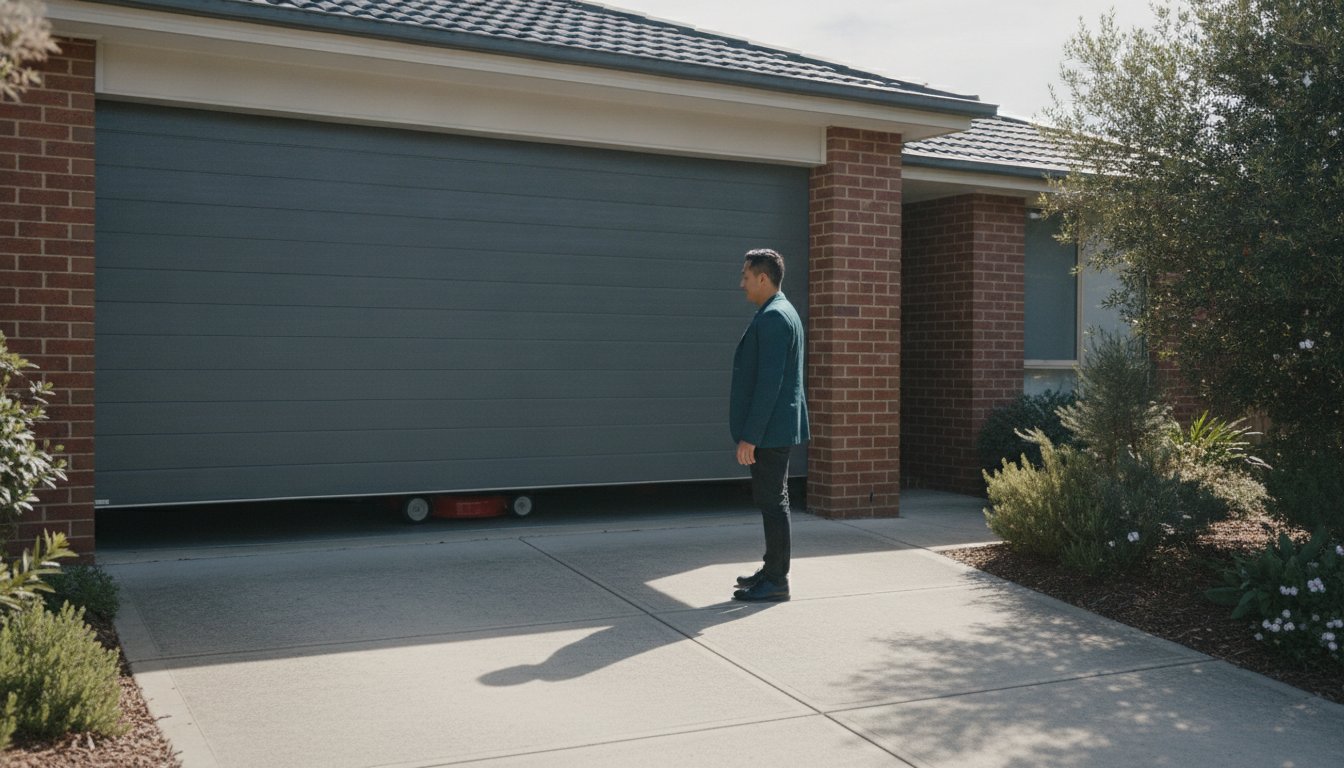
Did you know that between July 2020 and June 2021, there were 3,068 garage-related accidents in Australia that resulted in hospitalisation? It’s a sobering statistic that adds a lot of weight to that moment of frustration when you find your garage door stuck halfway. Whether you’re worried about your car being trapped inside or the potential cost of a major mechanical repair, the anxiety is completely understandable. You want a solution that is fast and affordable; however, you also need one that won’t compromise your family’s safety.
We agree that a malfunctioning door is more than just a nuisance; it’s a genuine security risk for your home. This guide promises to help you identify the root cause of the jam and walk you through the safe, practical steps to get things moving again without risking your fingers or your motor. We will preview the most common culprits, from simple sensor obstructions to complex spring issues, so you can decide if the fix is a quick five-minute task or if it requires a specialist like Matt from Brimbank. By the end, you’ll have a clear path toward a working door and a secure, functional home.
Key Takeaways
- Learn why you should never force a garage door stuck in its tracks, as this often leads to expensive motor damage or serious safety hazards.
- Discover how to identify common obstructions like garden tools or Melbourne dust that frequently clog roller door guides in the western suburbs.
- Recognise the visual warning signs of a snapped torsion spring to understand when your door’s heavy lifting mechanism has failed.
- Master basic maintenance techniques, including proper lubrication, to close the “service gap” and prevent future mechanical jams.
- Determine exactly when a repair is too dangerous for a DIY approach and requires a local specialist to ensure your home remains secure.
Why is Your Garage Door Stuck? Immediate Safety and Assessment
A garage door stuck in its tracks is a major disruption to your daily routine. We define this issue as any interruption in the smooth vertical travel of your roller or sectional door. Before you touch a single component, remember the golden rule of garage maintenance: never force a stuck door. Whether you are using the automatic opener or your own physical strength, applying force usually leads to far more expensive repairs than the initial jam. Your first step should always be a calm visual assessment to determine if the problem is electrical or mechanical.
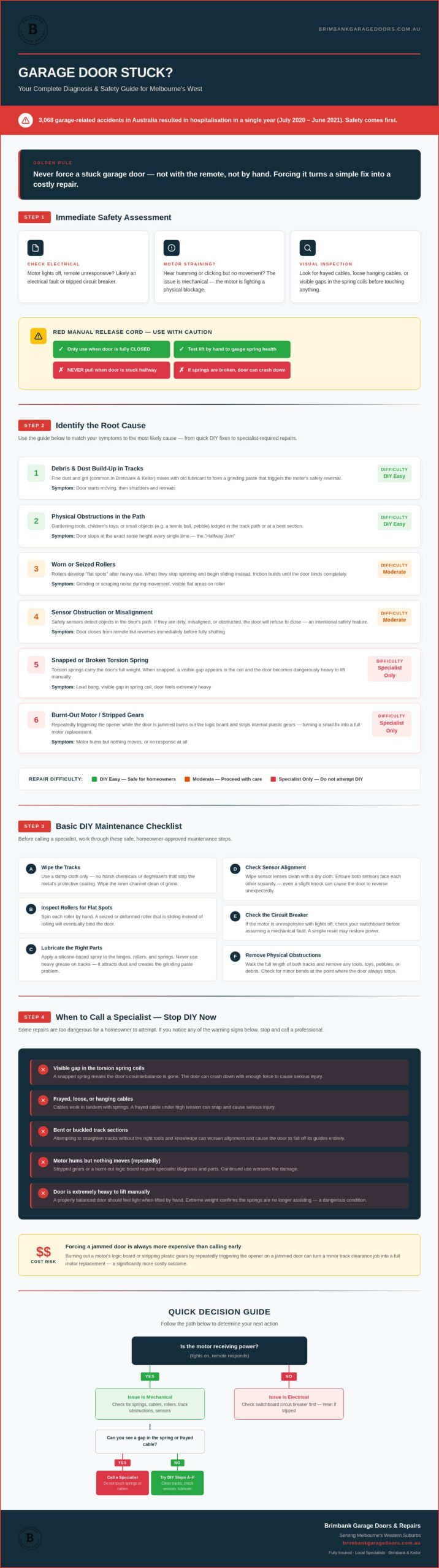
Start by checking if the motor is receiving power. If the lights on the unit are off and the remote does nothing, you likely have an electrical fault or a tripped circuit breaker. However, if you hear the motor straining or clicking, the issue is almost certainly mechanical. Walk around the door and look for obvious signs of trouble. Are the cables frayed or hanging loose? Is there a visible gap in the coils of the springs? These visual cues help you understand the scale of the problem before you attempt a fix.
The Danger of Forcing the Opener
When a door won’t budge, the natural instinct is to keep hitting the remote button in hopes that it eventually clears. This is a mistake that can cost you hundreds of dollars. Repeatedly triggering the garage door opener mechanism while the door is jammed can quickly burn out the motor’s logic board. You also risk stripping the internal plastic gears that allow the motor to move the chain or belt. If you hear a humming sound but see no movement, the motor is struggling against a physical blockage. Ignoring these signs garage door needs repair often turns a simple adjustment into a total motor replacement.
Using the Manual Release Safely
The red manual release cord is designed for emergencies, but it must be used with caution. Pulling this cord disconnects the door from the motor carriage, allowing you to move the door by hand. However, you should never pull the release if the door is stuck halfway up. If the springs are broken, the door loses its balance and can crash down with enough force to cause serious injury. Only use the manual release when the door is in the fully closed position. Once released, try to lift the door manually to test the weight. If it feels incredibly heavy, your springs are no longer doing their job. When you’ve cleared the obstruction, simply pull the cord back toward the motor to re-engage the trolley for automatic use.
Common Obstructions: When the Garage Door is Stuck Due to Debris
In Melbourne’s western suburbs, the environment plays a surprising role in how your garage functions. We often see a garage door stuck because of the fine dust and grit common in areas like Brimbank and Keilor. When wind-blown debris enters your garage, it settles into the vertical tracks and mixes with old lubricant. This creates a thick, grinding paste that increases friction and eventually triggers the motor’s safety reversal system. If your door begins to move but then shudders and retreats, a physical blockage is the most likely culprit.
Physical obstructions aren’t always microscopic. We frequently find that gardening tools, children’s toys, or even a stray tennis ball have been nudged into the track’s path. The “Halfway Jam” is a classic sign of this; if the door stops at the exact same height every time, look for a pebble or a minor bend in the track at that specific point. Modern systems are designed to back off the moment they detect resistance, adhering to federal safety standards that prevent the door from crushing objects or people. If the tracks look clear but the door remains stubborn, a quick bit of professional garage door maintenance can often resolve the alignment issues you can’t see with the naked eye.
Clearing the Tracks and Rollers
Cleaning your tracks is a simple DIY task that requires nothing more than a damp cloth and a bit of patience. Avoid using harsh chemicals or degreasers that can strip the protective coating off the metal. Wipe the internal channel of the tracks to remove built-up grime. You should also inspect the rollers for “flat spots.” If a roller has stopped spinning and has been sliding instead, it will eventually bind and leave your garage door stuck. Never apply heavy grease to the tracks; it only serves as a magnet for more grit. If you notice a minor bend in the track, a gentle tap with a rubber mallet can sometimes straighten it, but stop immediately if the metal doesn’t respond easily.
Photo-Eye Sensor Troubleshooting
Your safety sensors are the “eyes” of your garage door. They live just a few centimetres off the ground, making them prime targets for cobwebs, dust, and inquisitive spiders. Check the small LED lights on each sensor; they should be solid, not flickering. The harsh Australian sun can also cause “sunlight glare,” which effectively blinds the sensor and prevents the door from closing. You might need to fashion a small cardboard sunshade to test if glare is the issue. Finally, check the wiring near the floor. Local rodents occasionally nibble on these low-hanging cables, breaking the circuit and leaving your door unresponsive for no apparent reason.
Mechanical Failures: Is the Garage Door Stuck Because of a Broken Spring?
Many homeowners believe the electric motor does all the heavy lifting. In reality, your opener acts as the “brain” that directs movement, while the springs are the “muscles” providing the counterbalancing force. A standard double garage door can weigh well over 100kg. Without the tension of a healthy spring, your motor simply isn’t designed to move that mass. If you find your garage door stuck at the bottom or moving only a few centimetres before stopping, you are likely dealing with a mechanical failure of the spring system. This is a common issue that necessitates professional garage door repairs melbourne residents often face as their systems age.
Springs have a limited lifespan, usually measured in “cycles” or every time the door opens and closes. When a spring reaches its breaking point, it often fails with a loud bang that sounds like a gunshot or a heavy object falling in the garage. This sudden release of energy is why federal safety standards for garage doors are so stringent; the tension involved is immense and potentially lethal. If you suspect a spring has snapped, do not attempt to lift the door manually, as the weight could cause it to crash down unexpectedly.
Identifying a Broken Torsion Spring
Most modern homes use a torsion spring, which is a large coil mounted on a metal shaft above the door opening. To check for failure, look for a visible gap of two to five centimetres in the middle of the coil. This gap indicates the steel has snapped under tension. If the spring is broken, the motor will likely hum or strain but won’t be able to pull the door up. We cannot stress this enough: never attempt to adjust or replace these springs yourself. The high torque required for installation makes this a job strictly for a qualified technician.
Frayed Cables and Drum Issues
Cables work in tandem with your springs to lift the door evenly. Over time, these steel cables can fray or develop “bird-nesting,” where the strands begin to unravel and bunch up on the drum spool. If a cable jumps off the drum, the door will hang at a crooked angle, leaving the garage door stuck and jammed against the tracks. This misalignment puts extreme stress on the rollers and tracks. If you notice a loose cable or a door that looks lopsided, it is time to call for garage door spring replacement western suburbs to prevent the door from falling off its tracks entirely.
Troubleshooting Guide: Fixing a Stuck Garage Door with Basic Maintenance
Most mechanical issues we encounter in the western suburbs stem from what we call the “service gap.” This is the period of time, often spanning several years, where a door is used daily but never inspected or lubricated. While modern systems are incredibly durable, they aren’t invincible. Small amounts of friction eventually snowball into a garage door stuck in its tracks. Establishing a consistent garage door maintenance melbourne routine is the most effective way to ensure your home stays secure and your car isn’t trapped at the worst possible moment.
Beyond cleaning the tracks, you should periodically inspect the hardware for signs of wear. The constant vibration of the motor can gradually loosen the nuts and bolts that hold the tracks and hinges in place. Use a socket wrench to gently tighten any hardware that looks like it is backing out. However, be careful not to over-tighten, as you can strip the screw holes in the thin metal of the door panels. If you find that the door is still noisy or jerky after tightening the hardware, it may be time for a professional garage door service to realign the system.
Lubrication: The Right Products for Melbourne
One of the biggest mistakes homeowners make is reaching for a can of WD-40 to fix a garage door stuck or squeaky. WD-40 is primarily a degreaser and solvent; it actually strips away existing grease and evaporates quickly in the intense Melbourne heat. This leaves your components bone-dry and prone to rusting. Instead, use a high-quality silicone-based spray for nylon rollers and hinges. For metal-on-metal contact points, such as the chain or the screw drive, a lithium grease is far more effective. Target the pivot points of the hinges, the roller stems, and the full length of the springs. Always wipe away any excess liquid to prevent it from dripping onto your car or driveway.
Testing the Balance of Your Roller Door
A well-maintained door should be easy to move by hand. You can test this by pulling the manual release cord and lifting the door to the halfway point. If the door stays in place without you holding it, it is perfectly balanced. Balance is the state where the spring tension perfectly offsets the door weight. If the door “creeps” upward, the springs are too tight; if it “slams” toward the floor, the springs have lost their tension. An imbalanced door forces the motor to work twice as hard, which significantly shortens the lifespan of the logic board and the internal gears. If your door fails this simple test, the springs require a professional adjustment to prevent a total mechanical failure.
Professional Repairs for a Stuck Garage Door in Melbourne’s West
While clearing a pebble from a track or wiping down a sensor is a straightforward task, mechanical repairs are a different beast entirely. There comes a point where “giving it a go” crosses the line into genuine danger. As we’ve discussed, the tension in garage door springs is immense; attempting to adjust these components without specialised tools can lead to severe injury. If your garage door stuck because of a snapped cable or a failed torsion spring, the safest move is to step away and call in a professional. A qualified technician doesn’t just treat the symptom; they perform a comprehensive diagnostic to find the root cause, ensuring the fix lasts for years rather than days.
Engaging a professional also provides the benefit of a warranty and the assurance that your home security remains intact. A door that doesn’t close properly is an open invitation to intruders, and a motor that strains against a jam won’t last much longer. Many homeowners worry about the cost, but finding affordable garage door repairs melbourne residents can trust doesn’t mean compromising on quality or safety. Before you book a technician, it’s helpful to understand how much does garage door repair cost so you can make an informed decision. Transparency is a core part of our service, and we believe homeowners deserve clear information before any work begins.
Why Local Expertise Matters in Melbourne’s West
Matt’s approach is built on providing reliable, honest service across Melbourne’s northern and western suburbs. When you call Brimbank Garage Doors & Repairs, you aren’t dealing with a faceless call centre or a sub-contractor from the other side of the city. You get direct communication with a local specialist who understands the specific challenges of our region, from the grit of the western plains to the common door brands installed in St Albans and Essendon. This local knowledge allows for faster response times and a more personalised level of care. We take pride in being the dependable neighbour who also happens to be a technical expert.
Booking a Professional Service with Brimbank Garage Doors & Repairs
When you book a repair visit, you can expect a thorough inspection of your entire system, a clear quote, and a professional fix. To help the process go smoothly, we recommend clearing any vehicles or storage items from the area around the door before the technician arrives. This allows for safe, unobstructed access to the tracks, motor, and springs. Remember that regular professional maintenance is the best way to prevent your garage door stuck from becoming a recurring nightmare. A quick check-up every 12 to 24 months keeps the “service gap” closed and your family safe. For peace of mind and expert results, contact Brimbank Garage Doors & Repairs for reliable repairs and get your home moving again.
Restore Your Home Security and Peace of Mind
Navigating a mechanical fault doesn’t have to be a source of constant anxiety. We’ve explored how small maintenance gaps lead to a garage door stuck in its tracks and why forcing the motor is never the answer. From identifying snapped torsion springs to clearing the grit of the western suburbs, you now have the knowledge to assess your home’s security safely. While simple cleaning and lubrication go a long way, knowing when to call in a specialist ensures that a minor repair doesn’t escalate into a dangerous situation or a total system replacement.
Matt at Brimbank Garage Doors & Repairs is a specialist in residential roller door repairs across Melbourne’s West. Whether you are in Sunbury, Keilor, or St Albans, you can count on high-quality replacement springs and reliable local workmanship that prioritises your safety. Don’t let a stubborn door keep your car trapped or your house vulnerable. Get your garage door moving again with Matt at Brimbank Garage Doors & Repairs and enjoy the confidence of a job done right. We are here to help you get back to your day with a door that operates as smoothly as the day it was installed.
Frequently Asked Questions
Is it safe to fix a stuck garage door myself?
It’s only safe to perform basic maintenance tasks like clearing debris from the tracks or aligning safety sensors. If you have a garage door stuck due to mechanical issues involving high-tension components like springs or cables, attempting a DIY fix is extremely dangerous. Most residential doors weigh over 100kg; without professional tools and training, you risk the door crashing down. Stick to cleaning and call a specialist for anything involving the door’s lifting mechanism.
Why does my garage door start to close and then go back up?
This behaviour is usually triggered by the safety reversal system detecting an obstruction. It could be a physical object in the path, built-up grit in the tracks, or misaligned photo-eye sensors. The Australian sun can also cause glare that tricks the sensors into thinking something is blocking the way. Check for cobwebs or dust on the lenses first. If the tracks are clear and sensors are aligned, the motor’s force settings might need a professional adjustment.
Can I still use my garage door if the spring is broken?
You should never attempt to operate a garage door with a broken spring. The motor is not designed to lift the full weight of the door without the counterbalancing force of the springs. Using the opener in this state will likely burn out the logic board or strip the internal gears. Even manual operation is risky; the door becomes a heavy, dead weight that could drop unexpectedly and cause serious injury or property damage.
How much does it cost to fix a stuck garage door in Melbourne?
The total cost depends entirely on the root cause of the jam. A simple service call to realign tracks or sensors will be different to the cost of replacing major components like a motor or torsion springs. Factors such as the type of door, the specific parts required, and your location in the western suburbs will influence the final price. It is best to request a professional on-site inspection to get an accurate assessment for your specific situation.
Why is my garage door stuck on one side and hanging crooked?
A crooked door usually indicates that a lift cable has frayed or jumped off its drum. This causes one side of the door to lose its support while the other remains under tension. It is a serious mechanical fault that leaves your garage door stuck and jammed against the vertical tracks. Do not try to level the door yourself. The uneven tension makes the door incredibly unstable and prone to falling out of the tracks entirely.
What kind of lubricant should I use on my garage door tracks?
You should use a high-quality silicone-based spray or a white lithium grease. Silicone is ideal for nylon rollers and hinges because it doesn’t attract as much dust. Lithium grease works best for metal-on-metal contact points like the chain or screw drive. Avoid using standard WD-40 or heavy automotive grease. These products often act as degreasers or magnets for Melbourne grit; this eventually leads to more friction and premature wear on your hardware.
How do I manually open a garage door that has no power?
You can open the door manually by pulling the red emergency release cord located near the motor carriage. This disconnects the door from the opener, allowing you to lift it by hand. Always ensure the door is fully closed before pulling the cord to prevent it from crashing down if the springs are weak or broken. Once the power returns, simply pull the cord back toward the motor to re-engage the automatic system for normal use.