
Imagine you’re rushing out for the morning school run in Caroline Springs or heading to work in Werribee when a loud bang echoes through your home. You press the remote, but your garage door barely flinches, leaving your car trapped inside. This sudden failure is almost certainly a broken garage door spring, a common but serious mechanical issue that brings your daily routine to a grinding halt.
We know how stressful it is when your home security feels compromised and you’re worried about the safety of your kids or pets near a heavy, unsupported door. While the urge to try a DIY fix is strong, the extreme tension in these coils makes it a high-risk task that requires expert handling. This guide will show you how to safely identify a snapped spring and why professional calibration is the only way to ensure your door stays on track. We’ll also preview the replacement process and help you find a dependable specialist in Melbourne’s western suburbs who values quality craftsmanship over a quick patch-up job.
Key Takeaways
- Learn how to spot the tell-tale signs of a broken garage door spring, from the “gunshot” sound of a snap to identifying the visible gap in your torsion coil.
- Understand the critical safety protocols to follow immediately after a failure, including why you should never touch the emergency release cord while the door is open.
- Discover how Melbourne’s unique climate impacts metal fatigue and why most residential springs are engineered for a specific 10,000-cycle lifespan.
- Find out why professional tension-calibration and replacing both springs at once is the most reliable way to keep your garage door balanced and operational.
- Identify how to secure a dependable local specialist in Melbourne’s West to safely get your car out of the garage and restore your home security.
Table of Contents
How to Tell if You Have a Broken Garage Door Spring
Identifying a failure before you try to operate the door can save you from a much more expensive repair bill. Most homeowners in Melbourne’s West first realise something is wrong when they hear a sound like a gunshot or a heavy thud coming from the garage. This isn’t your imagination; it is the sound of a high-tension steel coil snapping under immense pressure. Because these springs store enough energy to lift a door weighing over 100 kilograms, the release of that force is violent and unmistakable.
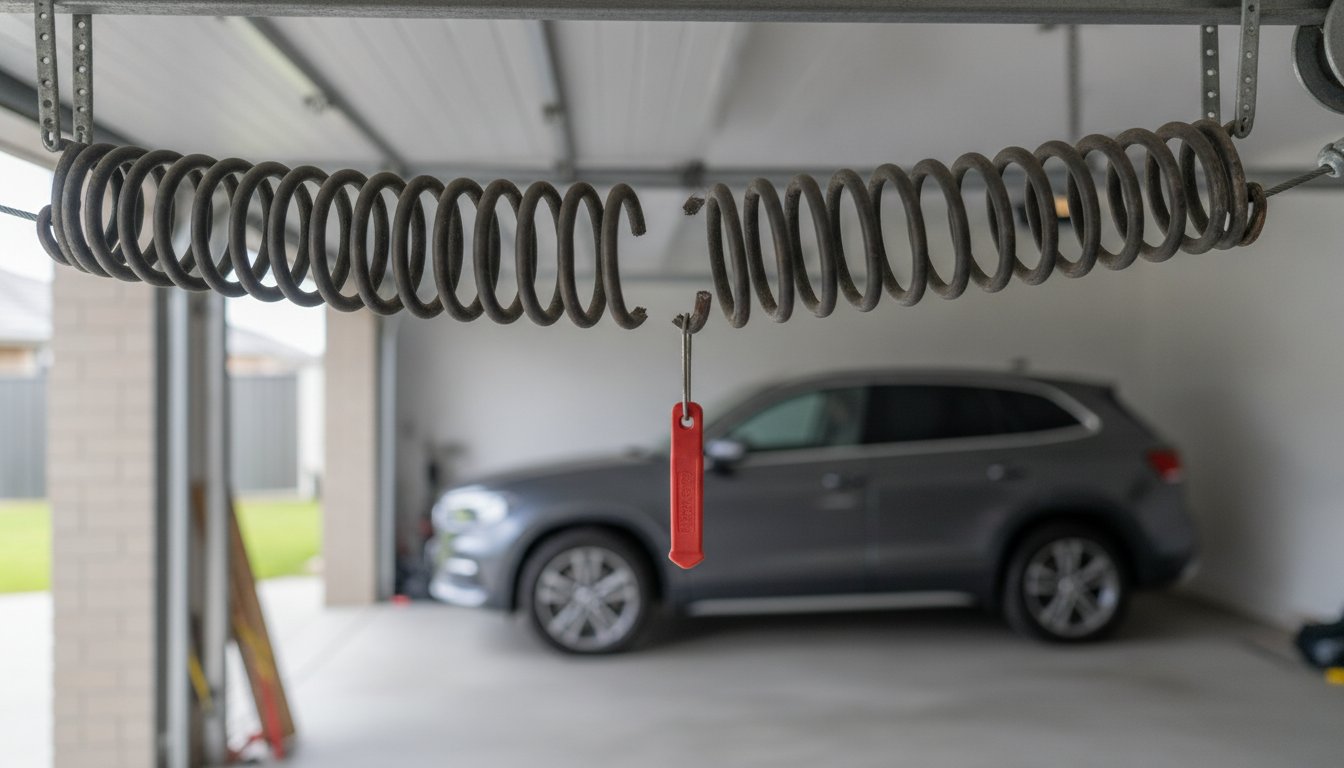
If you missed the sound, your next clue will be a visual one. Walk into your garage and look at the metal shaft above the door opening. If you have a torsion spring system, you will likely see a clear two-inch gap where the coil has separated into two pieces. This visible break is the “smoking gun” of a broken garage door spring. You might also notice that the steel cables on either side of the door look loose, frayed, or have jumped off their drums entirely. Without the tension of the spring to keep them taut, these cables become a tangled mess that can further jam the tracks.
The Telltale Signs of a Snapped Spring
Beyond the loud bang, keep an eye out for these specific physical symptoms. A door with a snapped spring will often hang crookedly in the tracks because the remaining tension is uneven. If you try to open it, you might see the door lift a few centimetres before stopping abruptly. Listen closely to your motor; if it makes a loud grinding noise or a strained humming sound without moving the door, stop immediately. These are clear indicators that the mechanical “muscle” of your system has failed, leaving the door as a dangerous dead weight.
Why Your Door Won’t Open (Even with the Motor)
It is a common misconception that the electric opener does the heavy lifting. In reality, the motor is merely the brain that directs the movement, while the spring is the muscle that carries the weight. When you have a broken garage door spring, the motor is forced to lift the full weight of the door alone. Most residential openers aren’t designed for this. If you keep pressing the remote button, you risk burning out the motor’s circuit board or stripping the internal plastic gears, turning a simple spring replacement into a full system overhaul.
You might be tempted to pull the red emergency release cord to lift the door manually. Be extremely careful. Without the spring to counterbalance the weight, the door can crash down with enough force to cause serious injury. If the door is already in the open position when the spring snaps, pulling that cord will cause it to drop like a guillotine. It is always safer to leave the door exactly where it is until a local specialist can secure it properly.
The Physics of Tension: Why Springs Break and Why It’s Dangerous
Every time you press your garage remote, the springs twist or stretch to counteract the door’s immense weight. Most residential springs are engineered for a “cycle life” of approximately 10,000 cycles. One cycle represents the door opening and closing once. If you use your garage four times a day, your springs have a functional lifespan of roughly seven years. Once the steel reaches its fatigue limit, a broken garage door spring becomes an inevitability. It is a simple matter of mechanical wear that eventually overcomes the integrity of the metal.
Melbourne’s weather plays a significant role in how quickly this fatigue sets in. Our city is famous for having four seasons in one day. These rapid temperature fluctuations cause the steel coils to expand and contract. Over time, this thermal cycling makes the metal more brittle. In the western suburbs, where frosty mornings often lead into scorching afternoons, this process is accelerated. If you haven’t performed regular maintenance, rust can also develop between the coils. This creates internal friction that generates heat, further weakening the wire gauge until the spring finally snaps under the strain.
The real hazard lies in the concept of stored energy. A torsion spring is wound under extreme torque, holding enough force to lift a 100-kilogram door with ease. When that spring fails, all that energy is released in a fraction of a second. It doesn’t just break; it lashes out. This force is powerful enough to shatter nearby windows, dent car panels, or cause life-altering injuries to anyone standing in the garage at the wrong moment.
Torsion vs. Extension Springs: Identifying Your System
In modern homes across Melbourne’s West, torsion springs are the industry standard. You will find these heavy-duty coils mounted on a metal shaft directly above the door opening. Extension springs are different; they are long, thinner coils that run along the horizontal side tracks. While torsion systems are generally more reliable, they are also under much higher tension. Regardless of which system you have, a failure in either one makes the door a dangerous dead weight that should not be operated manually.
The Risks of DIY Spring Repair
Attempting to fix a broken garage door spring yourself is a high-risk gamble. Replacing them requires specialised winding bars to safely apply and lock in the torque. Most homeowners try to use screwdrivers or pliers, which are prone to slipping under pressure. If a tool slips while the spring is half-wound, the resulting kickback can cause broken bones or severe facial injuries. Beyond the physical danger, an incorrectly tensioned spring leaves the door unbalanced. This puts immense strain on your motor and can lead to the door crashing down unexpectedly. For your peace of mind, it is always wiser to have a local specialist handle the precise calibration and heavy lifting.
Immediate Steps to Take When Your Spring Snaps
The first few minutes after a spring fails are critical for your safety. Once you have identified a broken garage door spring, your priority must shift from trying to fix the problem to securing the area. The tension that was previously held by the steel coil is now gone, meaning the full weight of the door is resting on the tracks or the motor arm. This creates an unstable and dangerous environment for anyone nearby.
Start by clearing the garage. Ensure children and pets are moved well away from the opening. If your car is partially under the door, do not attempt to drive it out. Even a slight movement could cause the door to shift and crash onto the roof or bonnet. Next, locate your garage door opener and unplug it from the power socket. This prevents anyone from accidentally pressing a remote or wall button, which would put immense strain on the motor and likely cause further mechanical damage.
One of the most dangerous mistakes you can make is pulling the red emergency release cord while the door is in the open or partially open position. Without the spring to act as a counterbalance, gravity will take over immediately. The door can drop with several hundred kilograms of force, potentially causing fatal injuries or crushing anything in its path. Leave the cord alone and keep the door exactly where it is until help arrives.
Securing Your Home and Vehicle
If your car is trapped inside, it is usually best to leave it there. Trying to lift the door manually, even with two people, is a recipe for back injuries and trapped fingers. For those worried about home security, if the door is stuck in a partially open position, you can use heavy-duty C-clamps on the tracks just above the rollers to prevent it from moving further. This is a temporary measure to keep the garage weather-tight and secure while you wait for a local specialist to arrive. If the door is already closed, simply keep it locked and avoid using it entirely.
What NOT to Do (The Safety Redline)
There are several common DIY “hacks” that actually increase your risk. Never attempt to loosen or remove the bottom brackets. These are still under significant tension from the cables and can fly off with lethal force if tampered with. Similarly, do not try to use a temporary clamp to “bridge” the gap in a broken garage door spring. This will not hold the weight of the door and will likely cause the spring to shatter further. Finally, ignore any advice about using lubricants like WD-40 on the break. A snap is a structural failure of the metal, not a friction issue; no amount of spray will restore the spring’s integrity.
Professional Replacement vs. Temporary Fixes
While a quick part swap might seem like a solution, a professional approach treats a broken garage door spring as a failure of the entire lift system. Most residential doors in Melbourne’s West operate on a dual-spring setup. Because these springs have worked in tandem for years, the surviving one has endured the same stress and is now holding the door’s full weight alone. Replacing both springs simultaneously is the industry standard because it ensures even tension and prevents a second mechanical failure within weeks of the first.
Precision is essential when selecting replacement parts. We match the exact wire gauge and length to the specific weight of your door. An incorrectly sized spring leads to an unbalanced door that either won’t stay closed or forces the motor to work too hard. A properly calibrated door should stay in a “neutral” position when halfway open. This precise balance is what keeps your roller door service components from wearing out prematurely.
Factors Affecting Spring Longevity in Melbourne’s West
In suburbs like St Albans and Keilor, environmental factors play a huge role in how your hardware ages. Fine dust from local development can settle between the coils, creating internal friction that generates heat and weakens the steel. This is often worsened by the high frequency of the “school run” cycle, where the door is cycled multiple times in a short window. Metal fatigue is the progressive structural damage that occurs when high-tensile Australian steel is subjected to repeated cyclic loading, eventually causing a total snap.
The Value of a Professional Inspection
A specialist doesn’t just replace the broken part; we inspect the whole system. While the springs are being swapped, we check the cables, drums, and rollers for signs of fraying or uneven wear. We also ensure your motor limit settings are adjusted to match the new tension levels. For more advice on keeping your hardware in top shape, check our garage door maintenance Melbourne guide.
If you’re looking for a reliable assessment, Brimbank Garage Doors & Repairs offers the technical expertise needed to get your door back on track safely.
Expert Garage Door Spring Replacement in Melbourne’s Western Suburbs
When you’re dealing with a broken garage door spring, you don’t want to wait for a national call centre to assign a random contractor. Residents across Melbourne’s West value the direct, personal accountability that comes with a local specialist. Brimbank Garage Doors & Repairs specialises in providing these technical solutions to families in Sunbury, Keilor, Essendon, and Caroline Springs. We understand that your garage is more than just a storage space; it’s a primary entry point for your home and a vital part of your daily routine.
Dealing directly with Matt ensures you get expert advice from someone who knows the specific hardware and environmental challenges of the western suburbs. We use high-quality replacement parts designed for Australian residential systems, ensuring your new springs are durable enough to handle the local climate. Our focus is on long-term home security, making sure every repair is completed to a standard we’d expect in our own homes.
Reliable Local Service from Brimbank Garage Doors & Repairs
By keeping our business focused on residential repairs, we provide a level of care that larger, commercial-focused firms often overlook. We prioritise prompt communication and transparent workmanship, ensuring you know exactly what is being fixed and why. For a more in-depth look at how we handle these high-tension systems, see our garage door spring replacement Western Suburbs pillar for more details.
Book Your Professional Inspection Today
Every broken garage door spring requires a specific calibration to ensure the door remains balanced and safe. When we arrive at your property, we assess the entire system to make sure your motor isn’t under unnecessary strain. We don’t believe in “quick fixes” that lead to more trouble later on. Contact Matt at Brimbank Garage Doors & Repairs for a reliable fix today.
Restore Your Home Security and Convenience
A failed garage system is more than a mechanical fault; it is a major disruption to your family’s safety and daily schedule. While the suddenness of a broken garage door spring is stressful, opting for a professional repair ensures your home is secured with parts designed for longevity. By choosing a solution that prioritises precision calibration over a temporary patch, you protect your motor and guarantee your door operates smoothly for years to come.
Brimbank Garage Doors & Repairs provides the technical expertise and local accountability that Melbourne’s western suburbs depend on. Matt’s hands-on approach means you receive reliable workmanship that larger corporations often overlook. Get your garage door fixed by a local Melbourne West specialist today and return to your routine with confidence. We are ready to help you secure your home and get your day back on track.
Frequently Asked Questions
Can I still open my garage door if the spring is broken?
Opening a door with a broken garage door spring is extremely dangerous and usually impossible for one person. Because the spring provides the mechanical lift, the door becomes a dead weight that can exceed 100 kilograms. Forcing the motor to lift this weight can burn out its circuit board or strip the internal gears. It is best to leave the door closed until a specialist can safely secure it.
How much does it cost to replace a garage door spring in Melbourne?
Costs for spring replacement vary based on the specific wire gauge, length, and the weight of your residential door. While we don’t provide flat rates due to the technical variables involved, a local specialist like Matt can provide an accurate quote after assessing your system. Factors like whether you have a single or double torsion setup will influence the final investment for your home’s security.
Why did my garage door spring make a loud noise when it broke?
The loud bang you heard is the sound of high-tensile steel suddenly releasing its stored energy. When a spring snaps, the torque is converted into sound and physical vibration instantly. Many homeowners in Melbourne’s West describe it as sounding like a gunshot or a heavy object falling in the garage. This violent release of force is exactly why you should never stand near a door during operation.
Should I replace both springs if only one is snapped?
You should always replace both springs at the same time to ensure the door remains perfectly balanced. Most garage doors are installed with a pair of springs that share the same cycle life and workload. If one has reached its fatigue limit and snapped, the remaining spring has endured the same wear and will likely fail within a few weeks. Replacing both prevents a second emergency call-out.
How long do garage door springs usually last in Australia?
Most residential springs are rated for approximately 10,000 cycles, which typically equates to seven to ten years of standard use. In Australia, local conditions like Melbourne’s coastal air or rapid temperature shifts can cause metal fatigue to set in earlier. Regular maintenance can help you reach the full lifespan of your springs, but once they hit that cycle limit, a snap becomes a matter of when, not if.
Is it dangerous to replace a garage door spring myself?
Yes, attempting a DIY replacement is highly dangerous due to the extreme tension required to wind the coils. Professional technicians use specific steel winding bars and safety protocols that most homeowners don’t have access to. A slip during the tensioning process can result in severe injuries, including broken bones or facial trauma. It is a high-risk task that is best left to a qualified local specialist.
How can I tell if my spring is just loose or actually broken?
A broken garage door spring is usually identified by a visible two-inch gap in the metal coil above your door. If the spring was simply loose, the door would feel heavy but might still move slightly. A complete snap means the coil has separated into two pieces, leaving the lift cables slack or tangled. If you see a physical break in the steel, the spring is definitely broken and needs immediate replacement.
Do I need to replace my whole door if the spring snaps?
You rarely need to replace the entire door just because a spring has snapped. In almost every case, a specialist can replace the failed springs and recalibrate the existing tracks and motor. Unless the door crashed down and caused structural damage to the panels or tracks, a spring swap is a standard mechanical repair that restores your door to full working order without the cost of a full installation.