

Can you safely balance a garage door yourself, or could a simple adjustment put you in harm’s way? If you’re searching for how to balance a garage door australia, the safest first step is to recognise the warning signs, not reach for the spring hardware. A balanced door moves smoothly with spring support, rather than relying on the opener to pull its full weight.
A door that feels unusually heavy, moves unevenly or won’t stay partially open can be unsettling. If the opener strains, reverses or struggles, the cause could be the springs, tracks or opener, and it may not be obvious by sight. This guide explains what balance means, how springs support the door and which signs call for attention. It also covers what you can safely observe, why high-tension springs should be left to a professional and when an assessment can help identify the issue.
Key Takeaways
- Balance depends on the spring system, not an opener setting or door alignment.
- Door style and spring arrangement affect how balance is assessed, so symptoms alone may not reveal the cause.
- Understand what you can safely observe and when to stop operating the door.
- If the door drops, moves unevenly or strains the opener, keep people clear and arrange a professional assessment.
- For residential garage doors across Melbourne’s western and northern suburbs, Brimbank Garage Doors & Repairs provides assessment, repairs and maintenance.
What does it mean to balance a garage door?
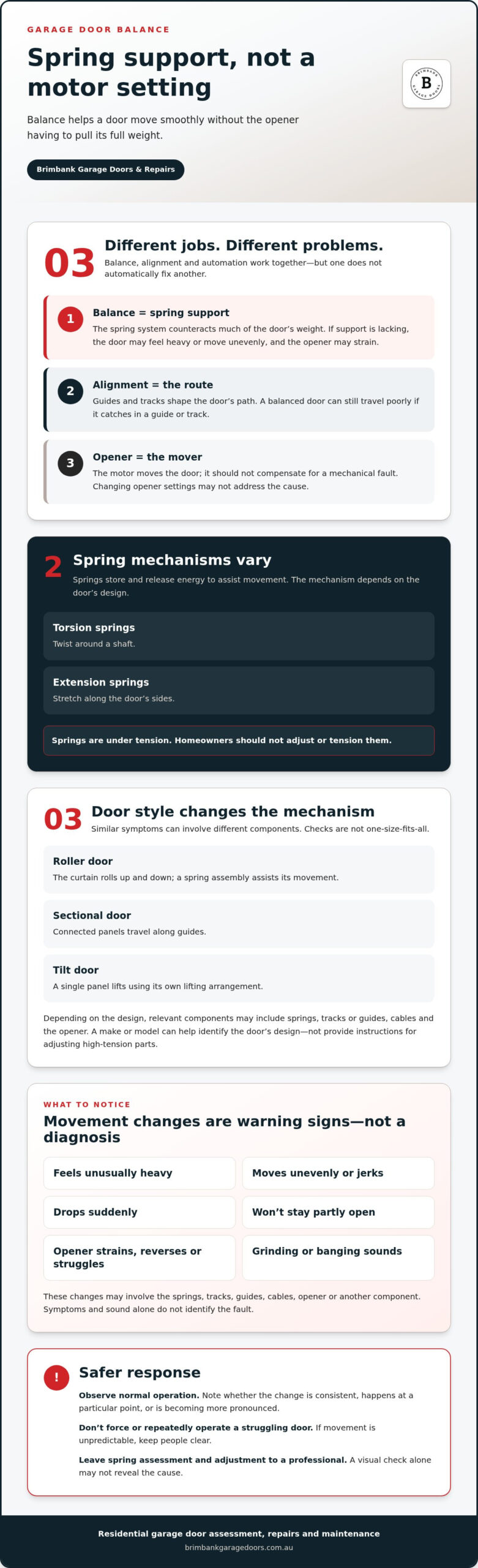
A balanced garage door has a spring system that counteracts much of its weight, helping it move smoothly and stay under control as it opens and closes. In simple terms, balance is the mechanical support that lets a door travel without the opener having to pull its full weight. It isn’t an opener setting, and it doesn’t mean the door is aligned correctly.
This distinction helps answer a common homeowner question: how to balance a garage door australia. Balance is about the springs and the load they support. Alignment is about the door’s path through its guides or tracks. Automation refers to the motor and controls that move the door. These parts work together, but a problem in one area won’t necessarily be fixed by changing another. A general overview of the Garage door operating mechanism also explains how springs can counterbalance a door’s weight.
If the spring system isn’t supporting the door properly, it may feel heavy or move unevenly, and the opener may strain. A motor might still move a door with a mechanical fault, but that doesn’t mean the fault has been fixed. Reliable operation depends on the door, springs, guides and opener working as they should.
How garage door springs support the door’s weight
Springs store and release energy to assist the door’s movement. As the door opens, spring tension helps counter its weight; as it closes, that support helps control the descent. The mechanism varies: torsion springs twist around a shaft, while extension springs stretch along the door’s sides. Roller and sectional doors can use different spring arrangements, so their balance is assessed according to their design. Springs are under tension and shouldn’t be adjusted by homeowners.
Balance, alignment and opener force are different issues
Think of balance as support, alignment as the route and the opener as the mover. A balanced door can still travel poorly if it catches in a guide or track. A door may also follow its path while its spring system fails to support its weight adequately. An opener should move the door, not compensate for a mechanical fault. If operation changes, the cause may need professional assessment rather than an adjustment to the motor’s settings.
These distinctions can help you describe what you’re noticing without guessing at the cause. A heavy-feeling door, uneven travel or an opener that labours can point to different issues, and a visual check alone may not show which component needs attention.
How garage door balance works across common Australian door types
A door’s style affects how its weight is supported and which components need inspection. A roller door coils above the opening, while a sectional door travels in panels along tracks. Tilt doors use a different lifting arrangement. The mechanisms aren’t interchangeable, so similar symptoms may call for different checks depending on the door.
Door type matters, so garage door balance checks aren’t one-size-fits-all. If you’re researching how to balance a garage door australia, focus first on what the door is doing and leave assessment of its spring system to a professional. A procedure for one door style may not apply to another.
Roller doors and their counterbalance system
A roller door’s spring assembly assists its movement as the curtain rolls up and down. Unusual resistance, uneven movement or a change in how the door operates could involve the spring assembly or another part of the system. These symptoms warrant assessment, but don’t identify the fault by themselves. Avoid accessing or tensioning the spring. A professional can assess the door’s operation and relevant components safely.
Sectional and tilt doors: why the mechanism can differ
Sectional doors move as connected panels along guides, while tilt doors lift as a single panel using their own lifting arrangement. Depending on the design, torsion or extension springs may be part of the mechanism, but these aren’t universal fittings. If you know the door’s make or model, the manufacturer’s information can help identify its design. Don’t treat it as instructions for adjusting high-tension parts.
For homeowners, the practical distinction is simple: notice how the door moves rather than trying to diagnose the spring layout. A roller door that feels resistant and a sectional door that travels unevenly may need different components checked. Depending on the door, tracks or guides, cables, springs and other parts may all be relevant. Keep people clear if movement seems unpredictable, and avoid repeatedly operating a door that is struggling.
A professional assessment can be matched to the door’s construction and help identify whether the concern relates to balance, travel or another mechanical issue. For residential roller doors in Melbourne’s western and northern suburbs, garage door repairs and maintenance can address unusual operation and support smoother, more dependable movement.
Signs your garage door may be out of balance
A change in how your garage door moves is worth noticing, particularly if it feels heavier than usual, travels unevenly or behaves differently from one operation to the next. These signs can point to a balance issue, but they don’t prove that a spring is broken. Tracks, guides, cables, the opener or another component may also affect operation.
If you’re looking into how to balance a garage door australia, observe what happens during normal operation rather than testing spring tension or forcing the door to move. Notice whether the change is consistent, occurs at a particular point in its travel or is becoming more pronounced.
Movement and sound changes worth noticing
Jerking, uneven travel, sudden dropping or unusual resistance are reasons to stop and arrange an assessment, not to push the door through its movement. Grinding or banging noises can also signal a mechanical problem, but sound alone won’t identify the cause. Note when the noise occurs and whether it’s new, repeated or getting worse. This information can help a technician assess the issue.
- Heavier movement: The door seems harder to move than it used to, or the opener appears to labour.
- Uneven travel: One side seems to move differently, or the door jerks, pauses or catches during operation.
- Uncontrolled movement: The door drops or doesn’t move in a steady, predictable way.
- New or worsening sounds: Grinding, banging or repeated straining accompanies the movement.
Why opener problems can point to a door issue
An opener may struggle if the spring system isn’t supporting the door properly or if another part is restricting movement. Repeated stopping or reversing can have other causes too, including an obstruction or a sensor issue, so it shouldn’t automatically be blamed on balance. Don’t increase the opener’s force to make a struggling door move. That can mask the symptom without addressing the mechanical problem.
Don’t try to confirm a suspected spring fault by handling or testing the springs, cables or brackets. Instead, keep people clear if the door’s movement seems unpredictable. From a safe distance, note whether it stops while opening or closing, where its movement changes, what sounds occur and whether the behaviour is worsening. Stop repeated operation if the door is jerking, dropping or straining, then arrange a professional assessment to identify the cause and appropriate repair.
What to do safely if your garage door seems unbalanced
If the door feels unusually heavy, drops or moves unpredictably, put safety first. Don’t keep operating it to see whether the problem clears. Repeated use can put further strain on the opener and make an unreliable door harder to control.
Take these simple steps instead:
- Stop repeated operation. If the door is jerking, dropping or struggling, don’t keep using the opener.
- Keep people clear. Make sure children and pets stay away from the door and its moving parts. Don’t stand beneath it.
- Observe from a safe distance. Note whether the door sits unevenly or whether you can see damage or a hanging cable. Don’t touch any components.
- Arrange a professional assessment. Describe what you’ve noticed and whether the change happened suddenly or developed over time.
Safe observations homeowners can make
A visual check can help you explain the problem, but it can’t confirm which part has failed. From a safe position, notice whether the door looks uneven, whether there’s visible damage or whether a cable appears to be hanging loose. Record what happens during normal operation only if it’s safe to do so. Don’t force the door, stand underneath it or handle springs, cables or brackets.
For routine care, the garage door maintenance checklist explains general upkeep. A checklist doesn’t replace repairs or an assessment if the door is already moving poorly.
Why spring adjustment is not a DIY task
Garage door springs hold substantial mechanical tension to help support the door’s weight. Loosening, winding, removing or replacing springs, cables or brackets without the right training can cause serious injury. Don’t attempt to adjust or dismantle these parts, even if the door appears to be only slightly out of balance. The garage door spring replacement guide for Melbourne’s western suburbs offers further information about springs without turning a hazardous repair into a DIY task.
If you’re searching how to balance a garage door australia, the safe next step is professional assessment, not spring adjustment at home. Brimbank Garage Doors & Repairs handles residential garage door repairs and replacement-spring work across Melbourne’s western and northern suburbs. Arrange a garage door assessment to help identify the issue and plan the appropriate repair.
When to book a professional garage door balance assessment in Melbourne’s west
Arrange an assessment if your residential garage door has become heavy, drops unexpectedly, moves unevenly or makes its opener strain. These changes are a good reason to stop relying on the door as usual, particularly if its movement seems unpredictable. Don’t try to compensate by forcing the door or changing opener settings. A professional can assess the mechanism and help identify the next step.
If you’re considering how to balance a garage door australia, the key is knowing when symptoms call for an expert rather than a DIY adjustment. A balance concern may involve the springs, but a restriction, worn component or another mechanical issue can produce similar behaviour.
What a technician may assess during a balance-related repair
An assessment takes account of the door’s movement and design, with relevant components inspected as appropriate. This may include the spring system, cables, guides or tracks, and the way the door operates. The aim is to understand what could be affecting its movement, rather than assume every heavy or uneven door has a spring fault. Keep clear of high-tension components and leave adjustment or repair to a professional.
For example, resistance during travel may relate to balance, but it could also point to a worn part or an obstruction in the door’s path. A technician can consider these possibilities while inspecting the system. The appropriate repair depends on the assessment, so don’t assume the cause or outcome in advance.
Choosing the right next step for a residential door
If the door drops, jerks, sits unevenly or strains the opener, stop operating it and arrange an assessment. Keep children and pets away, and don’t stand beneath the door or handle springs, cables or brackets. If it appears stable and you’re looking for general guidance, the Melbourne roller door repairs guide covers residential repair considerations.
Brimbank Garage Doors & Repairs provides residential garage door repairs, maintenance and replacement-spring services across Melbourne’s western and northern suburbs. A local assessment can help address a door that isn’t moving reliably. Arrange local garage door repair support.
Keep your garage door moving safely and smoothly
A well-balanced garage door relies on its spring system to support its weight, while alignment and opener operation are separate parts of the picture. If the door feels heavy, drops, moves unevenly or makes the opener strain, treat the change as a warning sign rather than trying to adjust the springs yourself. Note what you observe, keep people clear and arrange a professional assessment.
Knowing how to balance a garage door australia starts with recognising when it’s safer to leave high-tension components alone. A technician can assess the door’s movement and relevant parts, whether the concern involves a roller door, sectional door or another residential design.
Brimbank Garage Doors & Repairs provides residential garage door repairs, maintenance and replacement-spring services across Melbourne’s western and northern suburbs. For practical local support, arrange local garage door repair support.
Frequently Asked Questions
Can I balance a garage door myself?
No. You can observe the door from a safe distance and note visible damage or changes in movement, but don’t adjust springs, cables or brackets. These parts can hold dangerous tension. If the door feels heavy, drops, moves unevenly or strains its opener, stop repeated operation and arrange a professional assessment. Don’t increase the opener’s force to compensate, as this may mask a mechanical fault rather than address it.
How do I know if my garage door is out of balance?
Unusual heaviness, uneven travel, sudden movement, repeated stopping or an opener that seems to strain can indicate a problem. These signs don’t confirm a spring fault, as other components may also affect operation. If you’re asking how to balance a garage door australia, begin by observing symptoms, not testing spring tension. Keep people clear and arrange an inspection if the change persists or the door’s movement seems unpredictable.
Is it safe to use a garage door with a broken spring?
It may be unsafe to operate a door with a broken or damaged spring. The door can become heavy, move unpredictably or put extra strain on the opener. Keep people clear, don’t try to lift or repair the door, and arrange professional help. If it’s already open, don’t work beneath it. Avoid touching springs, cables or brackets, as these components can remain under tension.
Can a garage door opener fix an unbalanced door?
No. An opener moves the door, but it can’t replace the support of a properly functioning spring system. Increasing the opener’s force may conceal a mechanical problem and add strain to the door or motor. If the door moves poorly, don’t change settings to force it to operate. Have the door and relevant components assessed so the cause can be identified and addressed appropriately.
How often should a garage door be checked for balance?
Follow the maintenance guidance for your door and pay attention to changes in its normal operation. If it suddenly feels heavy, moves unevenly or becomes noisy, arrange an assessment rather than waiting for scheduled service. Don’t carry out a spring-tension test yourself. Regular professional maintenance can help identify wear, while prompt attention to new symptoms may help prevent a small concern from becoming a larger repair issue.
Do roller doors and sectional doors use the same balancing system?
Not always. Roller, sectional and tilt doors can have different designs, components and spring arrangements, so one adjustment method won’t suit every door. The door type and its condition influence what needs to be assessed. Don’t apply instructions meant for a different design or attempt spring adjustments yourself. A technician can inspect the specific door and determine which components may be affecting its movement.
What should I do if my garage door drops or moves unevenly?
Stop operating the door repeatedly and keep children, pets and other people clear. Don’t touch the springs, cables or brackets, stand beneath the door, or force it open or closed if it’s stuck. Note what happened from a safe distance, then arrange a professional inspection. For residential doors in Melbourne’s western suburbs, Brimbank Garage Doors & Repairs can assess the door and help identify the appropriate next step.