
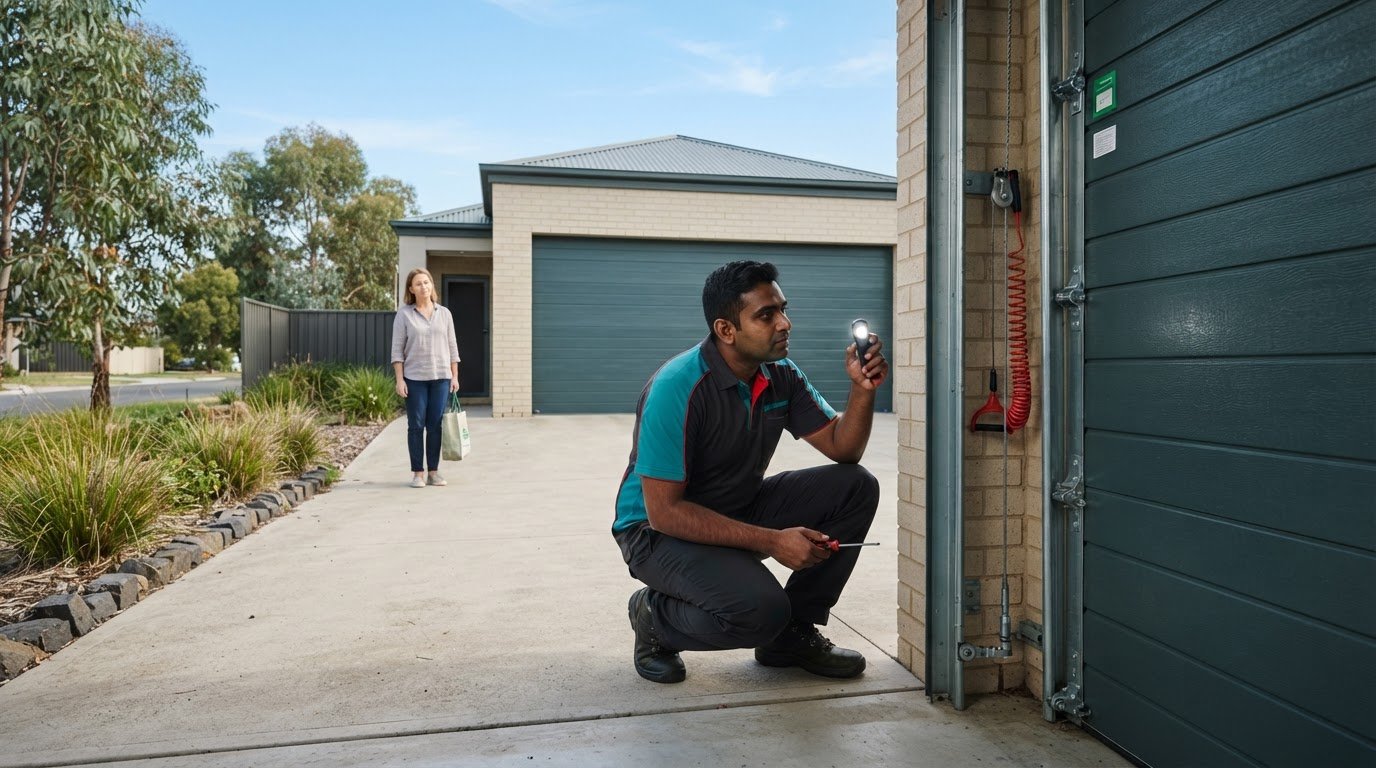
According to the International Door Association, 75% of all garage door failures are a direct result of inadequate maintenance. Most homeowners know that sinking feeling when an unsettling grinding noise rattles through the garage, bringing the quiet dread that a spring might snap and trap the family car inside. Conducting a routine garage door health check Melbourne residents can rely on is the best way to catch mechanical fatigue early, long before high-tension hardware gives out completely.
You shouldn’t have to guess whether your overhead door is genuinely safe to operate. In this guide, you’ll discover how to inspect your system safely, spot subtle warning signs like track misalignment or cable wear, and maintain smooth operation through Melbourne’s volatile seasonal shifts. We’ll walk you through a practical multi-point visual check you can carry out this weekend, clarify what simple maintenance is safe without specialised tools, and explain exactly when it’s time to call a qualified local technician.
Key Takeaways
- Conducting a routine garage door health check Melbourne homeowners can manage helps catch early track friction, worn rollers, and motor strain before severe hardware failure occurs.
- Master the manual balance test safely using your opener’s emergency release cord to check if your door stays balanced at mid-travel without mechanical assistance.
- Recognise the clear boundary between safe DIY cleaning or lubrication and high-risk components like torsion springs and cables that require professional attention.
- Discover how Melbourne’s reactive basalt clay soils and rapid seasonal temperature shifts pull tracks out of alignment and put unnecessary drag on your opener.
- Set up an effective maintenance schedule combining simple monthly visual checks with regular professional servicing to protect your home security and hardware lifespan.
What Is a Garage Door Health Check and Why Does It Matter?
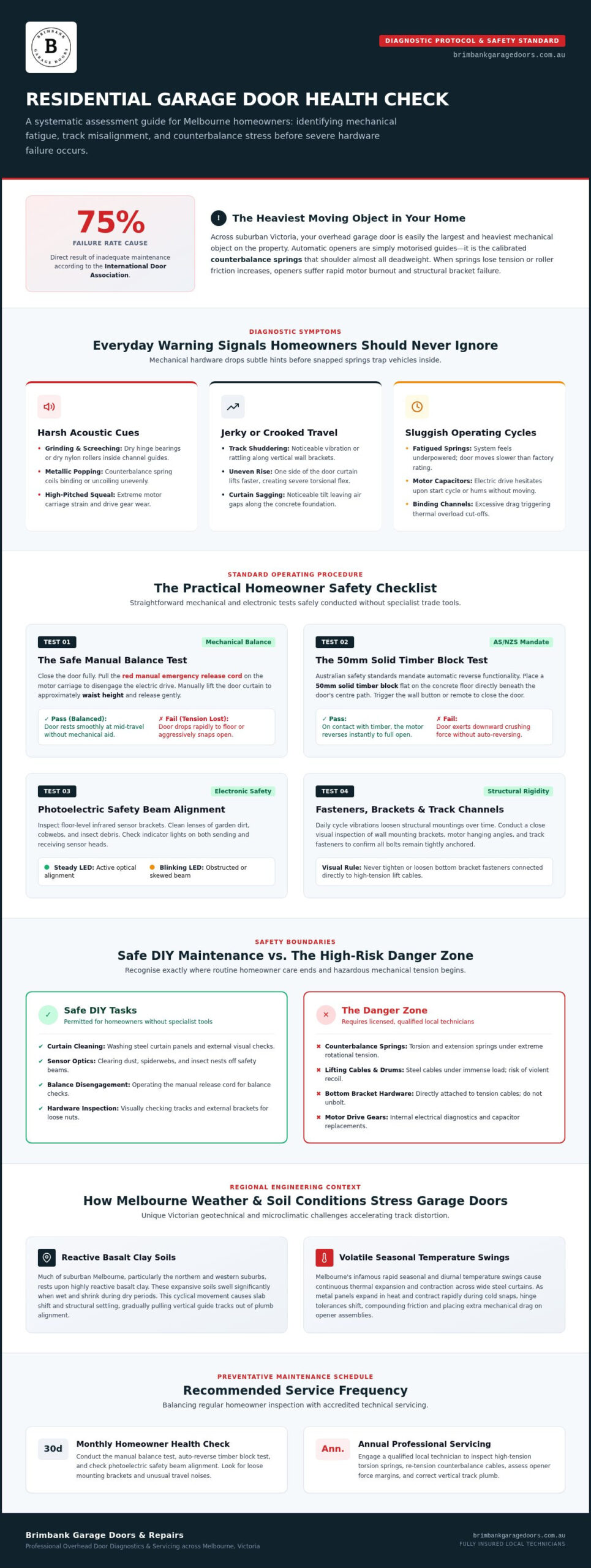
A comprehensive garage door health check is a systematic assessment of your door’s mechanical balance, structural alignment, hardware integrity, and active safety mechanisms. Across suburban Victoria, your garage door is easily the largest and heaviest moving mechanical object on the property. While a casual glance confirms whether the door opens and shuts, a structured health check inspects the working components underneath that daily strain.
Skipping preventative diagnostics allows minor friction to compound quickly. Misaligned tracks or dry hinge bearings quietly force your opener to pull harder, eventually triggering motor burnout or abruptly snapped counterbalance springs. To keep your system running smoothly through every season, explore our complete garage door maintenance Melbourne guide for seasonal upkeep steps.
The True Mechanics of Residential Overhead Doors
Many homeowners assume an automatic opener does the physical heavy lifting. In reality, calibrated counterbalance springs shoulder almost all the door’s deadweight. A quick review of the mechanical design behind what a garage door is shows that electric units are simply motorised guides. When springs lose proper tension, or when nylon rollers wear down inside their tracks, the opener takes on excessive drag. Pushing these motors past their operational limits quickly strips drive gears and strains structural brackets.
Early Warning Signals Homeowners Should Never Ignore
Mechanical hardware rarely gives up without dropping a few hints first. Arranging a proper garage door health check Melbourne homeowners trust becomes vital if you notice any of these everyday warning signs:
- Harsh noises: Grinding, high-pitched squealing, screeching, or sharp metallic popping sounds during travel.
- Jerky or crooked movement: Noticeable shuddering along the vertical tracks, an uneven rise, or visible sagging along one side of the door curtain.
- Sluggish operating cycles: A door moving noticeably slower than usual, pointing to fatigued counterbalance springs, worn motor capacitors, or binding track channels.
Catching these red flags early keeps your household safe and prevents an unexpected breakdown from trapping your car inside before the morning commute.
The 6-Point Homeowner Safety Checklist: Safe DIY Checks
You don’t need specialised mechanical tools to evaluate your door’s basic condition. Conducting a DIY garage door health check Melbourne residents can safely carry out involves simple sensory checks and functional tests. Crucially, safe home maintenance focuses strictly on external hardware, leaving high-tension torsion systems untouched.
Performing the Safe Manual Balance Test
Start with your door completely closed. Pull the red manual emergency release cord hanging from the motor carriage to disengage the electric drive. Next, lift the door manually by hand up to roughly waist height and let go carefully. A correctly balanced garage door remains resting smoothly in mid-travel without falling down or springing upward. If the panel feels exceptionally heavy, drops rapidly to the floor, or aggressively snaps open, your counterbalance springs have lost correct tension and need urgent professional calibration.
Testing the Auto-Reverse Mechanism and Sensor Eyes
Australian safety standards mandate auto-reverse functionality on all residential automatic openers to prevent crushing accidents. You can test this safety mechanism in two straightforward steps:
- The timber block test: Place a 50mm solid timber block flat on the concrete floor directly beneath the door’s centre path. Press your button to close the door. As soon as the bottom edge contacts the timber, the motor should detect the resistance and instantly reverse to the fully open position.
- Infrared safety beam inspection: If your setup includes floor-level photoelectric beams, clean dirt, cobwebs, and insect nests off each sensor lens. Ensure both brackets point directly at one another. A steady LED confirms active alignment, whereas a blinking light signals an obstructed or skewed beam.
Visual Examination of Brackets, Fasteners, and Roller Tracks
Vibration from daily cycles gradually loosens structural mountings. Look over your wall brackets, motor hanging angles, and track fasteners to confirm every bolt remains securely anchored to the garage framing. Examine the steel tracks for physical pinching, dents, or metal grit buildup along the running channels.
Keep in mind that guide tracks must stay completely free of heavy grease or standard WD-40. Sticky lubricants attract dust and road grime, turning into an abrasive sludge that jams rollers and ruins bearings. If your visual check spots bent tracks or your manual balance test fails, contact the team at Brimbank Garage Doors & Repairs to re-align your assembly without risking severe injury.
The Danger Zone: Components Requiring Licensed Professional Testing
A sensible DIY garage door health check Melbourne residents can conduct stops at visual inspection and light surface cleaning. Beyond that boundary lies the danger zone. High-tension overhead parts store massive mechanical force, making improvised home repairs hazardous to your safety and property.
| Component | Failure Symptom | DIY Hazard Level | Technician Procedure |
|---|---|---|---|
| Torsion Springs | Visible 50mm coil separation, loud bang, door won’t lift | Extreme (Critical trauma) | Winding-bar tension release, dual-spring replacement, torque calibration |
| Lift Cables | Fraying strands, loose loop, drum unraveling | High (Laceration, sudden fall) | Locking bottom corners, cable restringing, synchronised tension leveling |
| Bottom Brackets | Corroded plate, sheared bolts, corner panel buckle | High (Violent spring release) | Clamping torsion shaft, relieving cable load before bracket exchange |
High-Tension Springs and Winding Mechanisms
Garage door springs operate under hundreds of kilograms of mechanical tension capable of inflicting critical blunt-force trauma if handled incorrectly. While roller doors conceal internal springs within the overhead barrel, sectional designs expose large torsion coils mounted directly on the steel shaft above the lintel. As steel ages through thousands of cycles, coils elongate, develop surface rust, and lose elasticity. When one coil cracks on a sectional setup, technicians always replace both simultaneously because the companion spring has endured identical metal fatigue.
Bottom Brackets, Drums, and High-Tensile Cables
Sectional lift cables anchor directly into the bottom corner brackets, permanently transferring the spring’s lifting force down through the entire door curtain. Never loosen or unbolt these bottom fixtures. Even when the door rests closed, tension remains live.
Inspect your cables purely with your eyes. Look for bird-caging, where twisted steel strands separate into loose loops, or instances where a cable has slipped out of its aluminium drum grooves. Uneven cables pull the curtain crooked, risking complete track derailment. If you notice slack cables, read our specialist garage door spring replacement western suburbs guide to understand how experienced trades safely manage these high-risk assemblies.
How Melbourne Weather and Soil Conditions Stress Your Garage Door
Local conditions in Greater Melbourne subject garage doors to unique physical stresses that generic maintenance manuals simply ignore. Between sudden temperature swings and ground movement, your door frame endures continuous micro-shifts. Performing a regular garage door health check Melbourne residents can tailor to our local climate ensures minor seasonal shifts don’t turn into catastrophic mechanical failures.
Reactive Basalt Clay and Slab Heave in Melbourne’s West
The western and northern suburbs, including Brimbank, Melton, and Wyndham, sit atop highly reactive basalt clay soils. These clays expand during wet winters and shrink dramatically throughout hot, dry summers. As the ground moves, the concrete garage slab shifts beneath your home. This foundation movement pulls structural portal frames out of square, pitching vertical steel tracks off plumb.
Telltale symptoms of slab heave include visible daylight gaps under one side of the bottom rubber seal, uneven door curtain levels, and distinct scraping noises near the top track headers. When vertical channels tilt even a few millimetres out of square, rollers bind tightly, overloading the motor drive gear.
Four Seasons in One Day: Thermal Expansion and Lubrication Breakdown
Melbourne’s rapid weather changes frequently bring 20-degree drops in a single afternoon. Rapid shifts cause large steel and aluminium curtains to expand and contract across their width. If your track clearances aren’t set with adequate tolerance, panels squeeze tightly into the guides during cold snaps, stalling the opener halfway through travel.
Lubricant choice matters just as much. Western suburbs properties face a mix of salty coastal breezes from Port Phillip Bay and airborne dust blown across inland plains. Using standard WD-40 or heavy petroleum grease creates a sticky paste that locks up roller bearings in winter. Instead, use a high-grade silicone spray lubricant specifically formulated for Australian conditions to protect moving parts without trapping grit.
When environmental shifts knock your hardware out of square, check our roller door repairs Melbourne guide to see how structural alignment problems are diagnosed. If your door binds, shudders, or drags against shifted jambs, book an alignment service with Brimbank Garage Doors to reset your track clearances safely.
When to Book a Professional Health Check: Servicing and Preventative Care
A reliable maintenance cadence balances quick monthly homeowner checks with an annual service by a qualified technician. While home checks catch obvious surface issues, fine mechanical tuning requires trade experience and specialised tools. Investing in routine servicing extends the operational lifespan of your residential door by years while protecting your motor from premature burnouts. Before scheduling a visit, review our garage door repair cost Melbourne pricing guide to understand what influences typical repair budgets.
The Step-by-Step Professional Servicing Protocol
- Spring tension calibration: Testing deadweight balance and winding torsion or barrel springs to optimal operating torque.
- Structural alignment: Plumbing distorted vertical tracks and re-torquing structural anchor bolts that loosen under cyclic vibration.
- Opener diagnostics: Inspecting internal drive gears, checking drive sprocket wear, and recalibrating digital travel limits and safety sensitivity.
- Targeted friction treatment: Applying industrial silicone lubricants to bearing plates, hinges, and torsion bushes while keeping running channels clean.
Choosing an Honest, Experienced Local Specialist in Melbourne
Selecting the right technician matters just as much as regular servicing. Large franchise call centres often send sub-contractors incentivised by pushy upselling, inflated part replacement quotas, or exaggerated safety hazards. Working directly with an owner-operator means you get honest assessments and accountable workmanship from someone who values their standing in the community.
Booking a thorough garage door health check Melbourne homeowners trust gives you direct access to an expert who understands residential sectional doors and roller doors inside out. When you partner with a dedicated local trade neighbour across Melbourne’s western suburbs, you receive transparent diagnostic advice, dependable service, and genuine peace of mind every time you press your remote.
Protect Your Home with Dependable Seasonal Upkeep
Keeping your garage door running quietly comes down to simple proactive care. By pairing quick monthly visual checks with annual servicing, you can easily stay ahead of seasonal ground movement, track binding, and hardware fatigue. Most importantly, respecting the danger zone around high-tension springs keeps your home and family safe.
When you need a thorough garage door health check melbourne homeowners can trust an owner-operated local specialist. Matt at Brimbank Garage Doors provides honest, dependable trade workmanship across Melbourne’s western and northern suburbs. Focusing strictly on residential roller door repairs, scheduled maintenance, and high-grade spring replacements, you get straightforward diagnostics without locked-in contracts or pushy upsells.
Restore smooth, whisper-quiet operation to your garage today. Book a comprehensive garage door health check with Brimbank Garage Doors and secure reliable performance through every season.
Frequently Asked Questions
How often should I get a garage door health check in Melbourne?
You should arrange a professional garage door health check melbourne specialist conducts at least once every 12 to 18 months, alongside simple monthly DIY checks. Melbourne’s dramatic temperature shifts and reactive clay soils cause hardware to loosen and misalign over time. Regular preventative maintenance catches early mechanical fatigue, preserving motor life and keeping your door operating safely throughout the year.
Can I lubricate my garage door tracks using regular WD-40 or grease?
No, you should never apply standard WD-40, automotive grease, or heavy oil to garage door tracks. These sticky substances attract road dust, debris, and pet hair, forming a thick, abrasive paste that gums up rollers and causes binding. Instead, wipe tracks clean with a dry rag and use a dedicated silicone-based lubricant exclusively on the steel wheel bearings, pivot hinges, and torsion bushes.
How do I know if my garage door spring is worn out or about to snap?
A worn spring often shows visible coil elongation, rust pitting, or small gaps between steel winds. Operationally, you’ll hear loud squeaks, notice jerky lifting cycles, or find the door feels excessively heavy during manual operation. If a spring snaps, it produces an explosive metallic bang resembling a gunshot, leaving a noticeable two-inch gap across the coil and rendering the door impossible to open.
What causes a garage door to reverse immediately upon hitting the floor?
This issue usually happens when the motor’s down-travel limit or downward force sensitivity is set too high. The opener detects the concrete floor as an unexpected obstacle and triggers the automatic safety reverse. Other common culprits include shifted photo-eye sensors, a degraded bottom rubber weather seal bunching up unevenly, or an unlevel floor slab caused by ground movement in Melbourne’s western suburbs.
Can a shifting house foundation or slab heave throw my garage door off track?
Yes, foundation movement is a frequent problem in areas built on reactive basalt clay. As the soil swells during wet weather and contracts in summer, the concrete garage slab shifts slightly. This movement distorts the garage portal frame, tilting vertical tracks out of plumb. When tracks lose alignment, rollers bind inside channels, placing intense strain on the motor and risking derailment.
Is it dangerous to adjust my own garage door spring tension at home?
Yes, adjusting garage door springs without trade training is exceptionally hazardous. Both sectional torsion springs and roller door barrel assemblies hold tremendous mechanical energy. Improvised adjustments using makeshift winding rods can cause the spring to violently slip or unwind, resulting in severe lacerations, broken bones, or worse. Tension calibration should always be left to a qualified residential garage technician.
What does a professional garage door health check service usually include?
A comprehensive garage door health check melbourne homeowners book covers a complete multi-point mechanical inspection. Your technician evaluates door balance, resets spring tension, aligns and secures track brackets, and checks cable integrity. The service also includes testing motor travel limits, recalibrating auto-reverse safety sensors, and lubricating bearing plates and hinges using professional-grade silicone products to ensure smooth, quiet operation.