
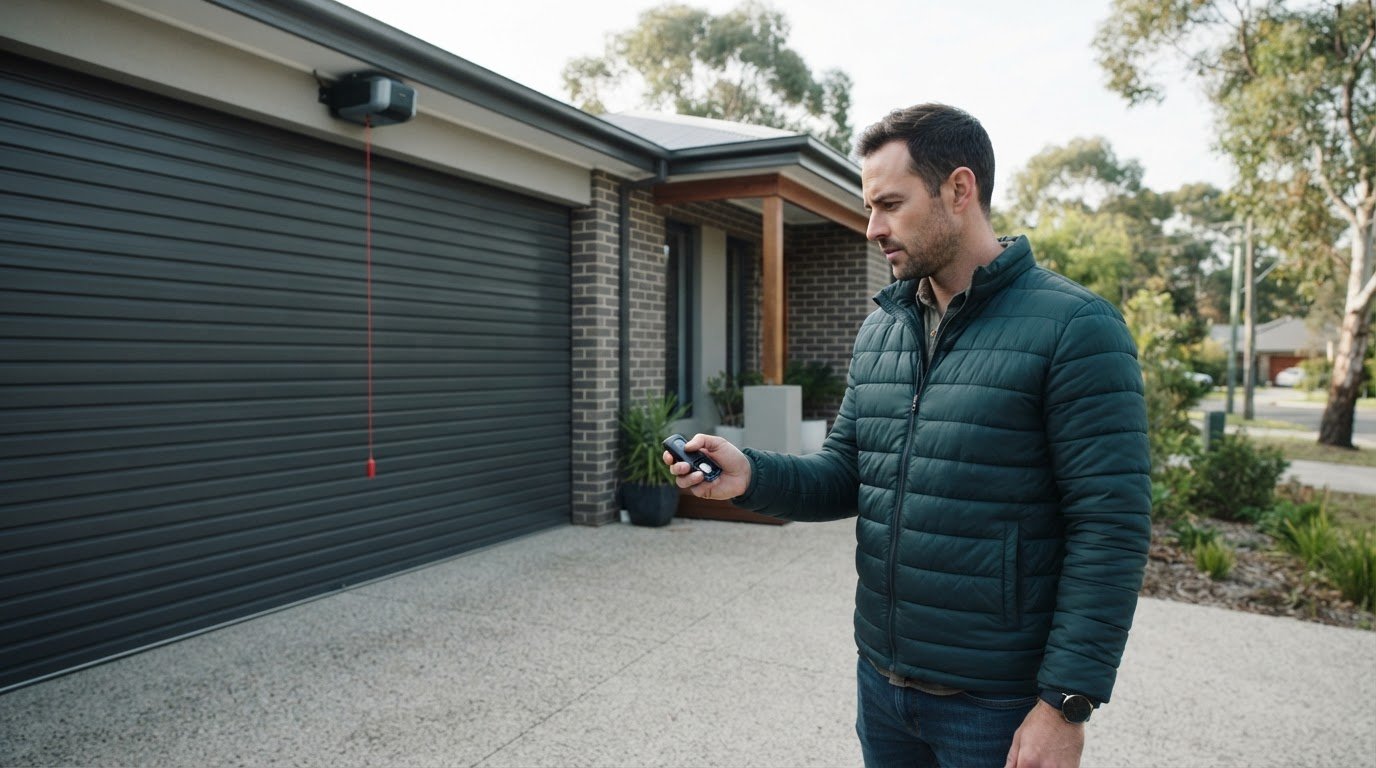
It’s 7:30 am on a brisk morning, you’re running late for the school drop-off, and your roller door won’t open with remote clicks no matter how hard you press the handset. That hollow click from the motor overhead only adds to the dread, leaving you trapped inside and wondering whether you’re facing a flat coin cell battery or a snapped spring.
We know how quickly that stress builds. When your car is stuck behind a stubborn steel curtain, it’s easy to worry that the entire opener has suffered catastrophic failure. In reality, handset faults usually stem from simple signal loss or dead batteries, while motor clicks and hums point toward physical track resistance or mechanical lockouts.
This 2026 guide gives you clear, practical steps to isolate whether the fault sits with your remote, receiver, or door balance. You’ll learn how to safely operate your manual release cord to free your vehicle and recognise when it’s time to call in an experienced local technician across Melbourne’s western suburbs.
Key Takeaways
- Learn how to tell whether a remote handset fault or a receiver board defect is the real reason your roller door won’t open with remote signals.
- Follow a systematic five-step handset diagnostic routine, covering button cell testing and enclosure checks, before inspecting the motor.
- Identify the mechanical warning signs behind motor humming, unmoving curtains, and severe track resistance.
- Master the critical safety rules for disengaging your manual release cord to avoid sudden curtain free-fall and personal injury.
- Recognise when high-tension counterbalance springs demand specialised tools and straightforward, local repair support across Melbourne’s west.
Why Your Roller Door Won’t Open With Remote Signals
Standing in front of a stubborn garage door with an unresponsive transmitter is frustrating. When your roller door won’t open with remote signals, jumping straight to the conclusion that the opener motor has burned out is a common mistake. Instead, an organised diagnostic triage will save you time, stress, and unnecessary expense.
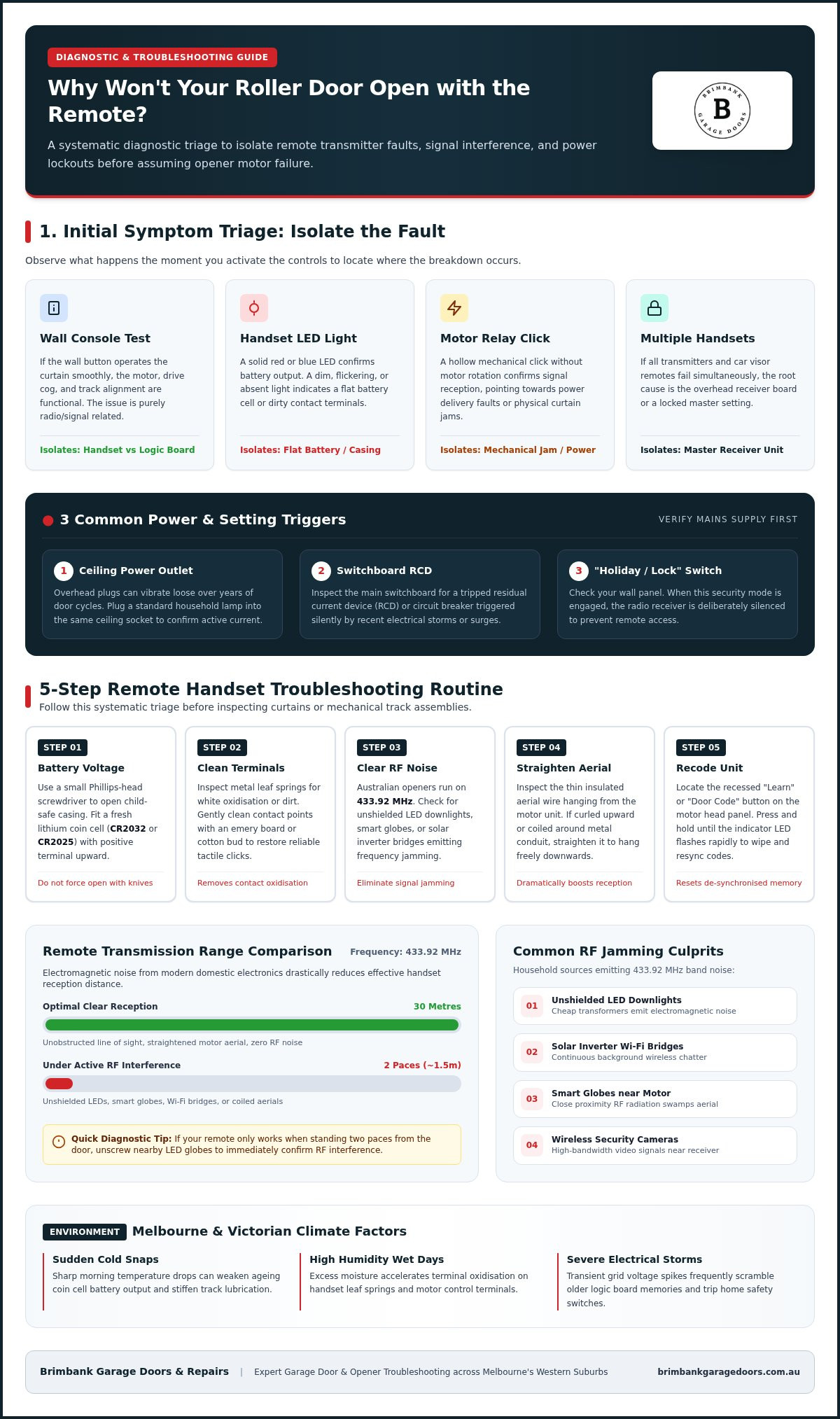
Start by testing the wall-mounted console inside the garage. If the wall button raises and lowers the steel curtain smoothly, your opener motor, drive cog, and track alignment are in good working order. That immediately isolates the fault to the radio frequency transmitter, the logic board receiver antenna, or a localised power setting. If neither the remote nor the wall switch triggers any movement, the issue sits with the primary power supply or internal motor electronics.
Weather plays a sneaky role across Victoria. Melbourne’s sudden cold snaps, high-humidity wet days, and severe electrical storms frequently trigger voltage spikes that scramble older logic boards or cause safety switches to drop out silently.
Recognising the Immediate Symptoms
Pay close attention to what your hardware does the instant you press the button:
- Handset LED activity: Check if the tiny red or blue LED on your remote lights up solid. A dim, flickering, or absent light indicates a flat battery or dirty internal contact.
- Motor relay clicks: Stand directly beneath the opener head unit and press the button. A distinct mechanical click without any motor spin confirms the receiver heard the signal, but the unit cannot feed power to the motor or the curtain is mechanically jammed.
- Multiple handset response: Test a spare key ring transmitter or your car’s integrated visor button. If all transmitters fail at once, the issue sits with the receiver board, not the individual handsets.
Common Electrical and Power Supply Triggers
Before assuming mechanical failure, confirm the drive unit is actually receiving mains electricity. Look up at the ceiling powerpoint to ensure the power plug hasn’t vibrated loose over years of door cycles. Plug a standard household lamp into that same outlet to confirm it delivers steady current.
Next, check your home’s main switchboard for a tripped residual current device (RCD) or circuit breaker. Finally, inspect your internal wall panel for an engaged “Lock” or “Holiday” switch. When switched on, this feature deliberately silences the radio receiver to stop remote break-ins, making homeowners think their roller door won’t open with remote controls due to a major breakdown.
Step-by-Step Remote Handset Troubleshooting
Working through transmitter diagnostics in a logical sequence prevents wasted effort. When your roller door won’t open with remote handsets, tackling the hardware methodically lets you pinpoint signal breakdowns before assuming the drive mechanism has failed.
Follow this 5-step triage process before touching the curtain or track assemblies:
- Confirm handset battery voltage with a fresh cell.
- Clean internal contacts and inspect the casing.
- Check the surrounding room for wireless signal interference.
- Inspect the overhead drive unit’s external antenna wire.
- Execute a clean memory cycle and recode the transmitter.
Battery Testing and Terminal Inspection
Australian consumer safety regulations enforce secure, child-resistant battery compartments on all remote controls. Use a small Phillips-head screwdriver rather than forcing the plastic casing open with a knife, which can crack the delicate circuit board inside. Fit a fresh lithium coin cell, usually a CR2032 or CR2025, ensuring the positive terminal faces upward as marked. Check the small metal leaf springs for white oxidisation or dirt buildup. Gently scraping the contact points with an emery board or cotton bud restores clean contact, ensuring worn tactile buttons register every click reliably.
Clearing Radio Frequency Interference
Most residential openers across Australia operate on the 433.92 MHz radio band. Unshielded domestic LED downlights, cheap smart globes installed near the opener, solar inverter Wi-Fi bridges, and wireless security cameras can emit electromagnetic noise that drowns out remote signals. If the operational range suddenly drops from thirty metres down to two paces from the door, unscrew nearby LED bulbs to test for frequency jamming. Next, check the thin insulated aerial wire hanging from the motor unit. If it has curled upward into the casing or wrapped around metal conduit, gently straighten it to hang straight down, dramatically boosting signal reception.
Reprogramming and Code Cycling
If the handset still fails, rolling-code memory corruption may have occurred inside the drive unit. Locate the recessed “Learn” or “Door Code” button on the motor head panel. Press and hold the button until the indicator LED flashes rapidly, clearing out old codes that may have de-synchronised over time. Once cleared, press the learn button once, followed immediately by your handheld remote button twice. The motor light will blink or click to confirm the handset has successfully paired. If signal issues persist after recoding, booking prompt garage door repairs will ensure a technician can test your receiver board directly without guesswork.
Motor Unit vs Mechanical Door Faults
When your roller door won’t open with remote activation despite a healthy handset, physical resistance is often the culprit. Garage doors are heavy, finely balanced systems where an electric opener simply guides movement, while internal springs perform the heavy lifting. In Melbourne’s western suburbs, shifting clay soils can cause structural frames to move slightly, nudging guide tracks out of parallel. Hot northerly winds across areas like Sunbury and Caroline Springs also blow fine dust into the tracks, creating intense friction that triggers modern motor safety cut-offs.
Symptom Comparison: Motor Logic vs Physical Resistance
Listening closely to the drive unit during operation helps separate electronic board glitches from physical door binding:
| Opener Sound | Visible Door Action | Probable Root Cause |
|---|---|---|
| Rapid Whirring | Motor spins freely; curtain stays stationary | Stripped internal nylon drive gear or disengaged drive collar |
| Straining Groan | Curtain lifts 50mm, shudders, then reverses | Broken internal counterbalance spring or physical track pinch |
| Single Relay Click | Complete silence; overhead light blinks | Overload trip, logic board fault, or blown motor capacitor |
When a motor whirs without lifting the steel curtain, the electric drive works fine, but internal nylon gears have likely sheared away under load. If the unit groans and stalls immediately, an internal counterbalance spring inside the drum axle may have snapped. Forcing the motor under these conditions burns out the internal windings, making professional roller door repairs melbourne essential to restore safe mechanical balance.
Guide Track Jamming and Drum Misalignment
Steel roller curtains must travel through a clean, friction-free channel. Dried garden debris, spider webs, or old petroleum grease packed inside the vertical steel guides will lock up the door. Roller door tracks should never be greased, because grease attracts road grit and turns into a sticky sludge that overloads the motor.
Look up toward the overhead roll to check for “telescoping”, where the steel curtain winds unevenly and creeps sideways off its drum wheel. Routine garage door maintenance melbourne checks, such as cleaning guide channels and inspecting drum brackets, keep mechanical resistance low so your roller door won’t open with remote failure symptoms caused by dirty hardware.
Safely Disengaging the Manual Release Cord
Reaching for the red manual release cord is your immediate lifeline when your car is trapped and your roller door won’t open with remote controls. That cord disconnects the automated motor from the drum assembly, allowing you to lift the curtain manually. However, that overhead rope demands absolute caution. Used incorrectly, particularly when an internal counterbalance spring has failed, it presents a serious hazard.
Never disengage the door into manual mode while the curtain sits open or partially raised. If an internal torsion spring has snapped, the motor drive gear might be the only component holding the door aloft. Pulling the release cord under tension allows the entire steel curtain to drop instantly, risking severe personal injury and vehicle damage. Only touch the manual cord when the door rests completely shut on the garage floor.
The Controlled Disengagement Procedure
Confirm the door is resting flat against the concrete slab before touching the release toggle. Once confirmed, pull the red cord firmly straight down or angled slightly towards the door curtain, following the directional indicator on the drive head. You should feel a definite mechanical click as the drive pin disengages from the drum wheel. The curtain is now completely free from the electric motor.
Testing Balance and Identifying Spring Failure
Once disengaged, you can safely test the mechanical health of your door:
- Two-handed lift: Grip the lifting handle or bottom rail firmly using both hands. The door should slide upward smoothly with minimal physical effort.
- Waist-height balance check: Stop lifting when the bottom rail reaches waist height and release your grip slowly. A healthy counterbalance spring pack will hold the door floating stationary in place.
- Detecting dead weight: Step away immediately if the curtain feels extraordinarily heavy or crashes back toward the floor the moment you let go.
A door that drops like dead weight confirms a broken internal spring pack. Forcing a heavy curtain open by hand can easily cause severe back injuries or track derailment. When torsion failure strikes, leave the door closed and arrange professional garage door spring replacement western suburbs service to restore proper tension.
If your roller door won’t open with remote inputs and the manual curtain feels jammed tight, don’t risk your safety. Contact Brimbank Garage Doors & Repairs for straightforward local advice and prompt mechanical repairs across Melbourne’s west.
When to Call a Professional Garage Door Technician
Basic transmitter checks and track clearing are sensible tasks for any handy homeowner. However, clear safety boundaries exist where DIY tinkering becomes genuinely dangerous. When your roller door won’t open with remote signals due to underlying mechanical binding, continuing to force the system risks damaging your property and causing serious physical injury.
Residential garage roller doors rely on high-tensile steel counterbalance springs packed inside the overhead axle drum. These springs store immense mechanical energy to offset the curtain’s physical weight. Attempting to unwind, adjust, or replace these tension components with standard household tools like vice grips or crescent spanners is hazardous. Professional technicians use purpose-built winding bars and tension clamps to manage these high-torque forces safely.
Red-Flag Faults Requiring Professional Tools
Stop immediately and disconnect power at the overhead point if you encounter any of these red-flag defects:
- Snapped internal springs: The door feels impossibly heavy to lift manually, or you hear a loud metallic bang inside the garage like a gunshot.
- Curtain axle bowing: The central steel axle has twisted or sagged, causing the rolled curtain to bind unevenly against the wall brackets.
- Loosened mounting brackets: The structural lag bolts securing the drum assembly to your brickwork or timber studs have worked loose under vibration.
- Scorched logic boards: The drive unit emits an acrid electrical burning smell following a storm or localized power spike.
Local Service Support Across Melbourne’s West
Living across Melbourne’s western and northern suburbs means dealing with unique local conditions, from intense summer heatwaves in Sunbury to heavy dust settling across developing estates in Caroline Springs and Keilor. These temperature swings cause metal components to expand and contract, accelerating internal mechanical wear on aging openers.
When you need reliable help, dealing directly with an experienced technician makes all the difference. Matt at Brimbank Garage Doors & Repairs provides residential service across the western suburbs with straightforward advice and zero pushy upselling. If your roller door won’t open with remote handsets and the issue sits deeper than flat batteries, you’ll get an honest, practical assessment of whether a component repair or a fresh unit replacement offers the most reliable long-term security for your home.
Restore Reliable Operation to Your Garage Roller Door
Dealing with a garage door that refuses to budge doesn’t have to derail your week. By systematically checking coin cell batteries, clearing radio frequency interference, and safely inspecting physical door balance, you can quickly pinpoint why your roller door won’t open with remote commands. When simple transmitter checks fail and high-tension internal springs or stripped drive gears are at fault, stepping back is always the safest choice.
That is where local technical experience counts. Backed by decades of hands-on expertise servicing residential garage roller doors, Brimbank Garage Doors & Repairs provides prompt, dependable workmanship across Melbourne’s northern and western suburbs. You’ll deal directly with experienced technician Matt, receiving straightforward advice without high-pressure sales tactics or unnecessary upselling. Take the frustration out of a stuck door and book a roller door inspection in Melbourne’s west today to get your home secure and moving smoothly again.
Frequently Asked Questions
Why is my garage door remote clicking, but the roller door won’t move?
A distinct click confirms the internal receiver relay is successfully hearing your remote signal and attempting to switch on. If the door refuses to budge, the motor is either not receiving operational voltage, the capacitor has failed, or physical resistance has jammed the curtain. When internal drive gears strip or high-tension springs break, safety limit circuits automatically freeze the motor to prevent further mechanical damage.
Can LED light bulbs in the garage stop my remote from working?
Yes. Standard household LED light bulbs often use unshielded driver circuits that emit electromagnetic noise across the 300 to 433 MHz radio bands. Because residential garage remotes broadcast on these exact frequencies, an illuminated LED globe can jam the motor receiver. If your remote only works when garage lights are turned off, swap them for RF-shielded garage door compatible bulbs.
How do I know if my garage door opener motor has burned out?
A burned-out opener motor usually produces complete silence despite confirmed power at the overhead point, or gives off a strong, acrid electrical smell. You might also hear a dull electrical buzz without mechanical rotation. If your switchboard hasn’t tripped and the manual wall button produces no response, internal motor windings or the logic board power supply have likely sustained terminal heat damage.
Is it safe to pull the emergency manual release cord if my remote fails?
It is only safe to pull the manual release cord when the roller door rests completely closed on the floor. If an internal counterbalance spring has snapped while the curtain is partially open, the motor gearbox is the only thing holding the door up. Pulling the toggle under load will cause the heavy steel curtain to crash down instantly, risking catastrophic injury.
How much does a replacement garage roller door remote typically cost in Australia?
Replacement costs vary based on whether you purchase a universal aftermarket transmitter, a genuine manufacturer-branded handset, or simple replacement coin cell batteries. Brand-specific rolling-code remotes carry proprietary frequency encryption and sit at the higher end of retail pricing. Having a local technician supply, program, and test your new handsets on-site ensures clean receiver pairing without frequency mismatches or security dropouts.
Why does my roller door remote work from inside the garage but not outside?
This common symptom usually indicates a failing coin cell battery. Weak batteries produce enough transmission strength to bridge a few paces within the garage, but lack the power to push radio waves through corrugated steel curtains or external brickwork. Straightening the motor antenna wire so it hangs clear of the casing will also improve range when your roller door won’t open with remote signals from the driveway.
Can cold weather in Melbourne affect whether my roller door opens?
Cold snaps across Melbourne cause metal curtains and steel tracks to contract slightly, while thick dirt and old residue inside the guides become far more viscous. This sudden spike in mechanical friction triggers the opener’s internal safety obstruction limits, halting travel. If your roller door won’t open with remote controls on chilly mornings, clean the track channels and inspect your counterbalance balance before winter sets in.