
Is your garage door actually a roller door, or are you looking at a sectional door without realising the difference? It’s a common point of confusion for many Melbourne homeowners. Understanding the various types of roller doors is essential before you commit to an installation, especially when you need to balance kerb appeal with practicalities like headroom and wind resistance. Whether you’re in a built-up street in Brimbank or facing the gusty winds of an open suburb like Sunbury, the door you choose needs to do more than just look good.
We know that choosing the wrong profile can lead to expensive headaches later, especially if the door is difficult to repair or doesn’t meet Australian Standards for wind ratings. You want a solution that offers long-term reliability and fits your specific garage layout perfectly. This 2026 guide simplifies the process by comparing materials and profiles so you can make an informed decision. We’ll walk you through how to measure your headroom, why certain materials outlast others in the Victorian climate, and how to find a local specialist who stands by their workmanship.
Key Takeaways
- Understand the mechanics of the classic Australian roller door to see why it remains the most efficient, space-saving option for local homes.
- Compare long-lasting materials like Colorbond and Zincalume to ensure your door stays resilient against Melbourne’s unpredictable weather.
- Learn how to distinguish between different types of roller doors and profiles to find the perfect fit for your garage’s specific headroom.
- Get a step-by-step guide on assessing local wind ratings and primary door usage to avoid choosing a model that isn’t fit for purpose.
- Realise the importance of expert installation and regular spring maintenance in preventing safety risks and ensuring your door operates smoothly for years.
Understanding the Fundamentals of Residential Roller Doors
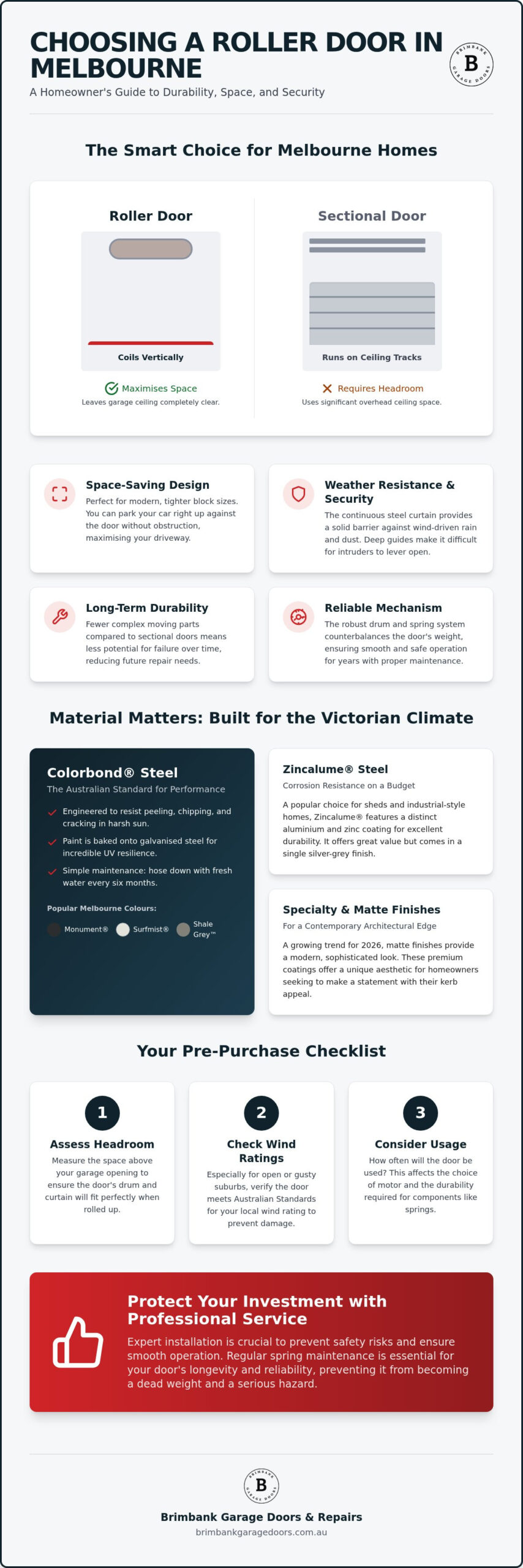
The classic Australian roller door is a masterpiece of functional engineering. Unlike sectional doors that require significant ceiling space or tilt doors that swing out into your driveway, a roller door operates vertically. The corrugated steel curtain travels within vertical guides on either side of the opening, coiling tightly around a drum located above the garage entrance. When Understanding Roller Door Fundamentals, it becomes clear that this design is the most space-efficient option available. It’s a simple, robust system that has protected Melbourne homes for decades. By choosing this style, you’re opting for a design that minimises moving parts and maximises reliability.
The Drum and Spring Mechanism
The internal spring is the heart of the door. Hidden inside the drum, this spring provides the tension needed to counterbalance the weight of the steel curtain. Without it, the door would be far too heavy to move. This is why high-quality garage door springs are essential for a reliable setup. If a spring loses tension or snaps, the door becomes a dead weight and a serious safety hazard. The drum itself acts as the axle, allowing the curtain to roll up into a compact bundle. This mechanism allows for a clean look and leaves your garage ceiling free for storage or lighting. It’s a straightforward approach to home security that works every time you press the button or lift the handle.
Benefits for Local Melbourne Homes
Choosing between different types of roller doors often comes down to your specific property layout. In suburbs like Brimbank or Sunbury, modern block sizes are often tighter than they used to be. A roller door is the perfect solution for maximising driveway space. You can park your car right up against the door without worrying about a swinging mechanism hitting your vehicle. The Victorian climate also plays a huge role in this choice. Our local weather can be unpredictable, with high winds and intense sun. A well-installed roller door offers several advantages for the average homeowner:
- Weather Resistance: The continuous curtain provides a solid barrier against dust and wind-driven rain common in Melbourne’s west.
- Security: Deep-seated guides make it difficult for intruders to lever the door open compared to lighter alternatives.
- Durability: Fewer moving parts than sectional doors means there is less that can go wrong over time, reducing the need for frequent repairs.
Whether you prefer a manual door for a backyard shed or a motorised version for your main garage, the fundamental design remains the same. It is a practical, no-nonsense choice that prioritises home security and longevity. Understanding these types of roller doors and how they function is the first step toward a garage that genuinely works for your lifestyle.
Comparing Materials and Finishes for Durability
When looking at different types of roller doors, the material you choose is your first line of defence against the elements. Most Melbourne garages rely on steel, but not all steel is created equal. The finish on your door determines whether it will still look fresh in a decade or if it will start to peel and rust after a few harsh Victorian summers. Choosing a durable material isn’t just about kerb appeal; it’s a long-term investment in your home’s security and your future maintenance schedule.
Colorbond Steel: The Australian Standard
Colorbond remains the dominant choice across Australia for its proven track record. In Melbourne’s western suburbs, we see a strong preference for colours like Monument, Surfmist, and Shale Grey. These shades don’t just look modern; they’re engineered to resist peeling, chipping, and cracking. The paint is literally baked onto the galvanised steel, making it incredibly resilient against the intense UV radiation we experience during peak summer. To keep your Colorbond door in top shape, a simple hose-down with fresh water every six months is usually enough to remove corrosive salt spray and road dust.
Specialty Finishes and Coatings
If you’re after a specific look, there are several alternatives to standard Colorbond. Zincalume is a popular choice for backyard sheds or industrial-style homes. It features a distinct aluminium and zinc coating that provides excellent corrosion resistance at a lower price point, though it only comes in one silver-grey finish. For homeowners seeking a contemporary architectural edge, matte finishes are a growing trend in 2026. These coatings provide a non-reflective, textured surface that resists fingerprints and looks exceptionally premium under afternoon sunlight.
The security of your garage also depends heavily on the “gauge” or thickness of the metal. Thinner steel is lighter and easier for a motor to lift, but it’s also more prone to denting from a stray basketball or a heavy storm. A thicker gauge steel provides a more rigid curtain, which is essential for meeting the latest Australian Garage Door Installation Standards. This extra thickness makes it much harder for intruders to force the door out of its tracks. If you’re currently weighing up these options, we can help you find the right balance between material strength and cost for your property.
Finally, for those with heritage-style homes, timber-look steel finishes have come a long way. You can now get the aesthetic warmth of a cedar or oak door without the warping and rot issues associated with real timber. These finishes use advanced grain-printing technology to mimic the look of wood while retaining the low-maintenance benefits of high-tensile steel. It’s a smart way to maintain the character of an older home while upgrading to modern security standards. Regardless of the finish, understanding the different types of roller doors and their material properties ensures you won’t be surprised by premature wear and tear.
Profiles and Configurations: Matching Door to Garage
Selecting the right profile is just as critical as picking the right colour. While the material provides the durability we discussed earlier, the profile determines whether the door will actually fit your garage structure. Standard profiles are the reliable workhorses of the industry, but they require a specific amount of space to roll up. If you’re dealing with a compact garage or a low-set ceiling, you’ll likely need to look at different types of roller doors like the mini-roll profile. These are designed with a smaller drum diameter to fit into tighter spaces without compromising on the strength of the steel curtain.
For homes in more exposed areas like Sunbury or the newer estates in Melton, the curtain design becomes a matter of safety. Deep-curtain profiles offer significantly more structural rigidity than shallow-curtain designs. This extra depth helps the door resist “blow-in” during the heavy wind gusts common in Melbourne’s north-west. When the wind picks up, a deep-curtain profile stays locked firmly within its guides, providing peace of mind that your garage and its contents are protected from the elements.
Headroom and Side-room Requirements
Before you fall in love with a particular style, you must measure your available space. Headroom is the vertical distance between the underside of the lintel and the lowest point of the ceiling or any obstruction like pipes or rafters. A standard residential roller door typically requires between 350mm and 450mm of headroom. Side-room is equally vital; you generally need about 100mm to 150mm on each side for the tracks and guides to be mounted securely. If your garage has restricted clearance, we often recommend specialised brackets or mini-roll configurations to ensure a smooth, unobstructed operation.
Security and Weather Sealing
A garage door is only as good as its seal. High-quality bottom weather seals are essential for keeping out the dust, leaves, and rain that Melbourne weather frequently throws our way. Beyond just weather protection, sealing roller doors plays a huge role in pest prevention, stopping rodents and insects from making a home in your garage. For security, you’ll need to choose between manual and motorised locking. Manual doors rely on physical waist-high locks, while motorised versions use the opener’s internal gearing to “deadlock” the door when it’s closed. Both types of roller doors offer excellent protection, provided the tracks and springs are maintained in top condition.
Choosing your operation style is the final piece of the puzzle. While manual doors are cost-effective for sheds or low-use areas, most Melbourne homeowners now prefer the convenience of a motorised system. Modern motors are quieter and more reliable than older models, but they do require a balanced door to function correctly. This is where the precision of the spring tensioning becomes vital. A door that is too heavy to lift manually will eventually burn out even the best motor, making professional calibration a non-negotiable part of the installation process.
How to Choose the Right Door for Your Melbourne Property
Choosing the right garage door involves more than just picking a colour from a swatch. To ensure you select the best fit from the various types of roller doors available, you need a systematic approach that considers both your lifestyle and the specific environmental conditions of Melbourne’s west. A door that works perfectly in a sheltered cul-de-sac may struggle in a wind-swept new estate in Melton. Following a clear set of steps will help you avoid costly mistakes and ensure your installation stands the test of time.
- Step 1: Assess local wind exposure. Open suburbs like Sunbury often require higher wind ratings to prevent the curtain from bowing.
- Step 2: Determine primary use. Will you be using the space for daily car parking, a secure workshop, or just seasonal storage?
- Step 3: Match the facade. Your garage door can take up to 40% of your home’s front profile; it must complement your existing architecture.
- Step 4: Future-proof your power. Even if you choose a manual door now, ensure there’s a power point nearby for a future motor upgrade.
- Step 5: Consult a specialist. A professional site measure is the only way to guarantee the tracks and drum will fit your specific headroom.
Climate Considerations for Melbourne’s West
Our local weather is famous for its “four seasons in one day” temperament. For homeowners in the western suburbs, thermal expansion is a genuine factor. Darker colours like Monument or Deep Ocean absorb significant heat, which can cause the steel to expand and contract slightly. This makes the precision of the initial installation even more vital. You also need to understand wind ratings. Most residential areas require an N1 rating, but if your home is on a hill or an exposed corner in a suburb like Sunbury, an N2 rating provides necessary structural reinforcement. Selecting the right types of roller doors for these conditions prevents the curtain from rattling or blowing out of its guides during a storm.
Aesthetic Alignment
A well-chosen door significantly boosts your home’s resale value by enhancing kerb appeal. For a cohesive look, try matching your door colour to your window frames or gutters rather than the brickwork. While bold colours can make a statement, neutral tones often age better and appeal to a broader range of future buyers. If you are unsure which profile or colour will suit your specific facade, we can provide expert advice on selecting a roller door that balances style with the practical needs of a Melbourne home. Taking the time to get this right now saves the stress of an aesthetic mismatch later.
Professional Installation and Ongoing Maintenance
Even the highest quality types of roller doors will underperform if the initial setup is flawed. While many home improvement projects are suitable for a weekend DIY approach, installing a garage door is not one of them. The primary reason is the high-tension spring system. These springs hold immense mechanical energy; if handled without the correct tools or expertise, they can cause serious injury or property damage. A professional installation ensures that the weight of the steel curtain is perfectly counterbalanced, allowing you to lift the door with a single hand or ensuring your motor doesn’t burn out prematurely.
During a professional garage door installation, the focus is on millimetre-perfect alignment. If the drum axle is even slightly out of level, the door will “telescope,” meaning the curtain rolls unevenly and rubs against the side guides. This creates friction that leads to unsightly scratches on your Colorbond finish and puts unnecessary strain on the mechanism. We take the time to ensure the tracks are plumb and the drum is centred, providing a foundation for years of smooth, quiet operation.
The Importance of Expert Fitting
Correct guide positioning is another technical detail that often goes overlooked. If the guides are too tight, the door will bind; if they are too loose, the curtain may rattle or “balloon” as it rolls up. Expert fitting also includes mandatory safety testing. For motorised versions, we verify the auto-reverse function. This ensures the door detects an obstruction and reverses immediately, which is a critical safety requirement for families with children or pets. We don’t just hang the door; we calibrate the entire system to meet Australian safety standards.
Servicing for Longevity
Once your door is in place, a regular maintenance schedule is the best way to protect your investment. Most homeowners should book a roller door service once every twelve months. This annual check-up allows us to re-tension the springs, lubricate the tracks with the correct silicone-based spray, and check for early signs of wear. Different types of roller doors have different service needs, but the goal is always the same: catching small issues before they become expensive repairs.
Keep an ear out for early warning signs of spring fatigue. If your door starts making a straining sound, or if it feels significantly heavier to lift manually, the springs are likely losing their tension. Dealing with a local specialist like Matt at Brimbank Garage Doors & Repairs means you get straightforward, honest advice from someone who understands the local conditions. We take pride in our residential workmanship across Melbourne’s west, ensuring your home remains secure and your garage door remains reliable for the long haul.
Securing Your Melbourne Home with the Right Door
Selecting the perfect garage door is a balance of local weather resilience, headroom clearance, and long-term repairability. You now understand how different types of roller doors can impact your home’s kerb appeal and security, from the durability of Colorbond steel to the technical precision required for spring tensioning. Whether you are facing the high winds of Sunbury or need to maximise space on a compact Brimbank block, the right choice starts with straightforward advice and a professional site measure.
Don’t leave your home’s security to chance or settle for a generic solution that might be hard to repair later. As a local owner-operator, I provide personalised service and expert knowledge of Melbourne’s West to ensure your installation is seamless and safe. We specialise in high-cycle replacement springs to keep your door operating smoothly for years to come. Get a reliable quote for your new roller door from Matt today and enjoy the peace of mind that comes with quality residential workmanship. Your garage is a vital part of your home; let’s make sure it’s protected by a door that’s built to last.
Frequently Asked Questions
What is the most durable type of roller door for Melbourne weather?
High-tensile steel doors with a Colorbond finish are the most durable choice for the Victorian climate. This material is specifically engineered to withstand intense UV radiation and the salt spray common in windy suburbs. When comparing various types of roller doors, look for a thicker gauge steel to ensure the curtain doesn’t dent or buckle under pressure. Regular maintenance, such as hosing off dust and grit, will further extend the life of the finish.
Can I change my manual roller door to an automatic one later?
You can certainly automate a manual door later, as long as the curtain and tracks are in good condition. The most important factor is the balance of the door; if the springs are worn, a new motor will struggle or fail. We always recommend a full service to ensure the door operates smoothly before installing an opener. This upgrade provides significant convenience and enhanced security for your Melbourne home without needing a full replacement.
How much headroom do I need for a standard residential roller door?
A standard residential roller door usually requires between 350mm and 450mm of headroom above the opening. This space allows the drum and the coiled curtain to sit comfortably behind the lintel without obstructing the passage. If your garage has restricted clearance, you might consider a mini-roll profile, which fits into smaller spaces. We always perform a precise site measure to determine which configuration works best for your specific ceiling height and side-room.
What is the difference between a roller door and a sectional door?
The main difference lies in how they open and where they are stored. A roller door coils up into a compact drum located directly above the opening, which saves valuable ceiling space. A sectional door is made of horizontal panels that slide up and back along tracks to sit flat against the garage ceiling. While both are popular types of roller doors and systems, the classic roll-up design is often more cost-effective and easier to maintain.
Are Colorbond roller doors better than powder-coated ones?
Colorbond is widely considered the superior choice for Australian conditions because the finish is baked onto the steel during manufacturing. This process makes it highly resistant to peeling, cracking, and the harsh Melbourne sun. Powder-coating is a separate process often used for custom colours not found in the standard range. While powder-coating looks great, it can be more susceptible to chipping if struck by debris or during heavy storms in the western suburbs.
How long does a typical garage roller door last before needing repairs?
A high-quality steel curtain can last 20 years or more, but the internal components typically require attention sooner. Garage door springs are rated for a specific number of cycles, usually lasting between 7 and 10 years depending on daily use. You’ll likely need minor repairs or a service every few years to keep the tracks aligned and the motor running quietly. Regular professional maintenance is the most effective way to prevent major mechanical failures.
Do I need a wind-rated roller door in the western suburbs?
Wind-rated doors are highly recommended for homes in exposed western suburbs like Sunbury, Melton, or newer estates with less wind protection. These doors are designed to meet Australian Standard AS/NZS 4505:2012, ensuring the curtain stays securely in its tracks during high gusts. An N2 wind rating provides extra structural reinforcement, preventing the door from blowing in or out. It’s a critical safety feature that protects both your property and your family’s security.
What should I do if my roller door feels heavy to lift manually?
If your door feels heavy, stop using it immediately and avoid trying to adjust it yourself. This is a clear sign of spring fatigue or a broken spring, meaning the door is no longer counterbalanced. Operating a motor on a heavy door will cause the gears to strip or the motor to fail. Contact a specialist to inspect the tension; professional spring replacement is essential for safety and to restore smooth operation to your garage door.