
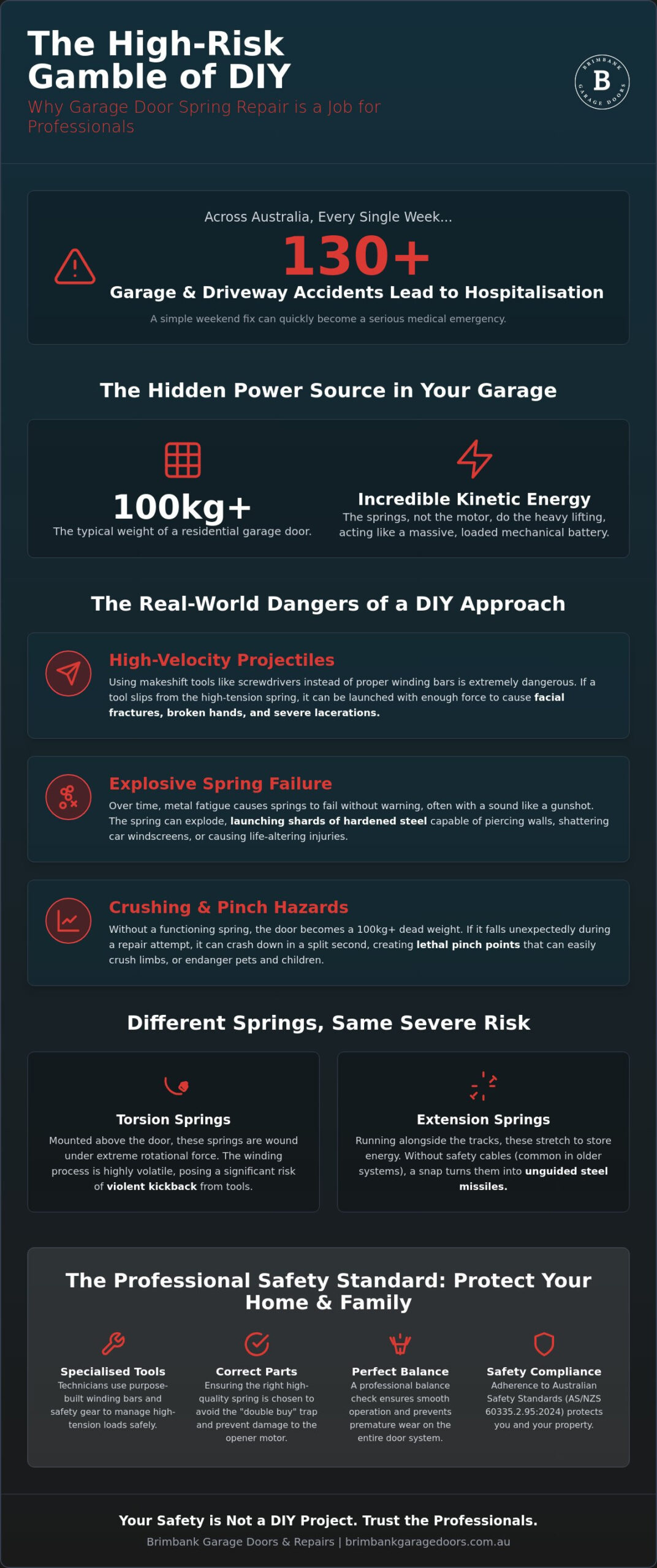
Did you know that over 130 garage and driveway accidents lead to hospitalisation every week across Australia? It’s a sobering figure that highlights why a quick weekend fix can quickly turn into a serious medical emergency. We understand the frustration of finding your car trapped behind a heavy door and the worry of being overcharged for a mechanical part. It’s tempting to grab the ladder and try to handle it yourself to save some time and money.
However, the dangers of DIY garage door spring repair are immense because these springs aren’t just under tension; they are high-velocity hazards that can cause life-altering injuries if they snap. This guide will show you why attempting this task is a high-risk gamble and how you can protect your home and family. We’ll explore the physical risks involved, the importance of the AS/NZS 60335.2.95:2024 safety standards, and why ensuring your door is perfectly balanced is critical for its long-term reliability.
Key Takeaways
- Understand that your garage door spring carries the full weight of the door, making it a high-tension component that requires specialised tools to handle safely.
- Discover the physical dangers of DIY garage door spring repair, including the risk of projectile steel fragments and severe injuries from slipping winding bars.
- Learn why Australian roller doors present a unique challenge due to their internal spring systems typically housed deep within the metal drum.
- Avoid the “double buy” trap by choosing the correct, high-quality replacement springs the first time rather than risking damage to your expensive opener motor.
- See how a professional balance check ensures your entire door system remains safe and functional, preventing premature wear on hinges and rollers.
Why Garage Door Springs Are the Most Dangerous Parts of Your Home
Many homeowners assume the electric motor is the muscle behind their garage door. In reality, the motor is just the conductor; the springs are the heavy lifters. A standard residential garage door in Melbourne can easily weigh upwards of 100kg, and the springs are designed to counterbalance that weight so the door feels light enough to move with one hand. To achieve this, the springs store an incredible amount of kinetic energy in their coils. When you wind these springs, you are essentially loading a massive mechanical battery that is constantly looking for a way to release its energy. Understanding how torsion springs work is vital to respecting the sheer power they hold. Torsion is the rotational force that can cause a winding bar to kick back with lethal speed if your grip slips for even a second. This mechanical reality is the foundation for the dangers of DIY garage door spring repair.
Torsion vs. Extension: Different Mechanics, Same Risk
Most modern homes in the western suburbs use torsion springs, which are mounted on a metal shaft directly above the door opening. These are particularly volatile during the winding process because the tension is concentrated in a tight, twisting coil. Extension springs, which run along the upper horizontal tracks, operate by stretching rather than twisting. While they might look less intimidating, they carry a unique risk. Older extension springs often lack internal safety cables. If they snap while under full load, they become unguided steel missiles capable of punching through a car’s windscreen or causing severe bodily harm to anyone nearby.
The ‘Snap’ Factor: What Happens at the Breaking Point
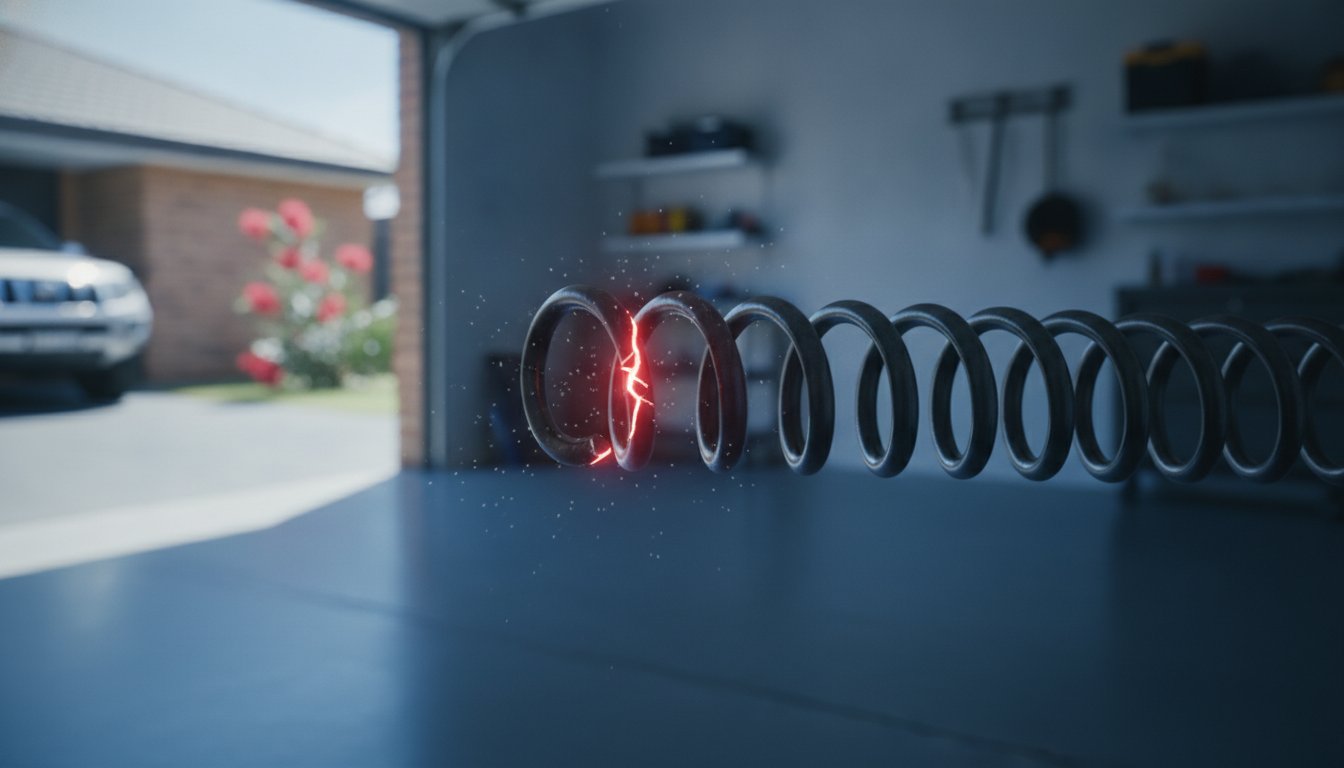
Metal fatigue is a silent threat that eventually claims every spring. Every time your door opens, the steel fibres in the spring stretch and compress. Over thousands of cycles, microscopic cracks form until the metal reaches its absolute limit. A spring rarely gives a warning before it fails; it simply lets go with a sound like a gunshot. The force released is instantaneous and violent. One of the primary dangers of DIY garage door spring repair is that a snap often occurs while an amateur is actively adjusting the tension. This puts the individual in the direct line of fire, where the stored energy is released toward their face, chest, or hands with devastating consequences.
The Real Risks of DIY: Projectiles and Projectile Force
When a garage door spring is under full tension, it stores enough energy to lift a massive steel door. Handling that energy requires specific tools called winding bars. One of the most significant dangers of DIY garage door spring repair occurs when homeowners attempt to use makeshift tools like screwdrivers or pliers. These substitutes lack the grip and strength required to hold the tension. If a tool slips, the spring unwinds instantly, turning the tool or the winding cone into a high-speed projectile. The resulting “kickback” can easily cause facial fractures, broken hands, or severe lacerations before you even have time to blink.
Projectile Injuries: More Common Than You Think
The violence of a snapping spring isn’t limited to the person holding the tools. When hardened steel fails under load, it doesn’t just drop to the floor; it often explodes. Shards of metal can fly across the garage with enough velocity to pierce plasterboard, shatter car windscreens, or cause life-altering injuries to anyone standing nearby. This recoil effect is a primary reason why the International Door Association (IDA) consistently recommends that spring repairs be performed only by trained professionals using proper tools. Without the right equipment and safety gear, you are essentially standing next to a loaded mechanical weapon. If you suspect your springs are failing, reaching out for expert garage door repairs is the safest way to protect your property and your health.
Crushing Hazards and Pinch Points
Without the assistance of a functional spring, your garage door becomes a “dead weight.” For many Melbourne homes, this means over 100kg of steel is held up only by your physical strength or a temporary prop. If the tension is released too quickly or a cable slips during a DIY attempt, the door can crash down in a split second. This creates lethal pinch points along the tracks and hinges that can easily crush fingers or limbs. Beyond the risk to yourself, a falling door poses a massive threat to pets or children who might wander into the garage while you are distracted by the repair.
The danger also extends to your stability. Most spring repairs require working from a ladder to reach the centre bracket or the winding cones. If a spring suddenly snaps or a tool kicks back, the shock can easily knock you off balance. Falling from a height while dealing with a heavy, moving door significantly increases the risk of a trip to the emergency room. Professional technicians are trained to manage these forces while maintaining a stable work environment, ensuring the door remains controlled at every stage of the process.
The Australian Roller Door: A Unique DIY Challenge
In many ways, the classic Australian roller door is a marvel of compact engineering, but it presents a unique set of obstacles for the home handyman. While international DIY guides often focus on sectional doors with visible springs, most homes in our local area rely on roller door repairs Melbourne professionals because the springs are entirely hidden. They are tucked away inside the metal drum around which the door curtains wrap. This “out of sight, out of mind” design makes it nearly impossible for an untrained eye to spot early signs of metal fatigue or corrosion until the door simply refuses to move.
Hidden Dangers Inside the Drum
One of the most significant dangers of DIY garage door spring repair on a roller door is the structural risk. To adjust the tension, you must interact with the U-bolts that secure the axle to the wall brackets. If you loosen these bolts without the proper support equipment or a deep understanding of the drum assembly, the entire door can slide out of its mounting. This isn’t just a repair fail; it’s a structural collapse that can crush anything or anyone beneath it. Matt specialises in these specific Australian systems, ensuring the door remains securely anchored while the internal tension is adjusted safely.
Specialist Tools vs. The ‘She’ll Be Right’ Approach
Attempting to tension a roller door with standard household wrenches is a recipe for disaster. Professional technicians use specialised pipe wrenches and tensioning bars designed to grip the axle firmly while it is under intense load. The “she’ll be right” approach often leads to “guessing” the tension, which causes the door to telescope. This is where the curtain rolls up unevenly, leading to permanent creases in the steel or a total jam that requires a full door replacement.
Online marketplaces often sell “universal” springs that claim to fit all doors, but these rarely account for the specific wire gauge or diameter required for your door’s weight. Using the wrong part can burn out your motor in weeks. For residents in Sunbury, Keilor, or Caroline Springs, seeking garage door spring replacement western suburbs ensures you get parts that meet Australian Standards and a door that is perfectly balanced. It’s about getting the job done right the first time so you don’t end up paying twice for the same repair.
The True Cost of DIY: Why Saving Money Often Backfires
It’s easy to see the appeal of a DIY fix when you’re looking at a broken spring and a tight budget. However, the financial dangers of DIY garage door spring repair often outweigh any initial savings. What looks like a simple part replacement can quickly spiral into a total system overhaul if the balance isn’t perfect. Most homeowners don’t realise that the spring’s primary job is to make the door weightless. If you install the wrong spring or tension it incorrectly, your motor has to pick up the slack, leading to the premature failure of your opener’s most expensive components.
Protecting Your Motor and Opener
An unbalanced door is a motor killer. Even if the door seems to move, an extra 5kg of “unbalanced” weight puts immense strain on the drive system. Most modern openers use precision gears designed for smooth operation, not for lugging dead weight. Overloading them will strip these gears or burn out the logic board in a matter of weeks. A professional technician doesn’t just swap the spring; they perform a comprehensive balance test to ensure the motor barely breaks a sweat. Spending a few hundred dollars on a professional spring fix is a smart investment that prevents a $1,000 motor replacement down the road.
Liability and Insurance Risks
Warranty coverage is another major hurdle for DIYers. Most manufacturers specifically state that their warranty is void if the product is not repaired by a qualified professional. If your amateur repair leads to a buckled door panel or a burnt-out motor, you’ll be footing the entire bill yourself. There is also the matter of home insurance. Many Australian policies won’t cover property damage or personal liability claims resulting from “unauthorised” or non-compliant mechanical work. This is why using a local business like Brimbank Garage Doors & Repairs is vital for accountability and long-term peace of mind.
Choosing a local expert provides you with an official invoice and a workmanship guarantee. This paper trail is essential for insurance purposes and provides peace of mind that the job was done to Australian Standards. When you factor in the specialised tools you’d need to buy and the hours spent struggling with high-tension parts, the garage door repair cost Melbourne homeowners pay for professional service is remarkably fair. Don’t risk your safety or your bank account on a high-stakes gamble. If your door is heavy or making strange noises, book a professional garage door repair with Brimbank Garage Doors & Repairs to get it sorted properly the first time.
Professional Spring Repair in Melbourne’s West: The Brimbank Safety Standard
When you call Brimbank Garage Doors & Repairs, you aren’t dealing with a call centre or a faceless franchise. You’re dealing directly with Matt, a local specialist who understands the unique architectural styles and garage door configurations found across Melbourne’s western suburbs. Whether you’re in Sunbury, Caroline Springs, or Keilor, you receive a level of personal accountability that large corporations simply can’t match. We prioritise safety over speed, ensuring that every repair adheres to the highest industry standards and local regulations.
Our commitment to your home’s security begins with a rigorous safety protocol. While an amateur might focus solely on the broken coil, we perform a full diagnostic of the entire system. This includes inspecting the lifting cables for fraying, checking the rollers for wear, and ensuring the hinges are securely fastened. By identifying these secondary issues, we eliminate the dangers of DIY garage door spring repair where a simple swap often ignores underlying structural weaknesses that could lead to a future collapse. Brimbank Garage Doors & Repairs only supplies and fits high-quality springs designed to withstand Melbourne’s variable climate, ensuring durability and long-term performance.
What to Expect During a Professional Service
A professional spring replacement is a meticulous process that begins with precise weight testing. We don’t guess which spring to use; we calculate the exact wire gauge and length required to balance your specific door. Once the high-quality springs are selected, we perform precision winding using professional-grade bars. The goal is a door that “floats”, meaning if you stop it halfway, it stays perfectly still at waist height without drifting up or crashing down. To keep everything running quietly, we finish with a high-grade lubrication of all moving parts. We always recommend regular garage door maintenance Melbourne to ensure these components stay in peak condition and to catch minor wear before it turns into a snap.
Your Next Steps for a Safe Garage
If you suspect a spring has failed, the most important thing you can do is stay clear. Do not touch the red emergency release cord; if the spring is broken, there is nothing holding the door’s weight, and it could crash down instantly. Avoid using the motorised opener, as the motor will likely burn out trying to lift the dead weight. Keep the door closed and keep family members and pets away from the area.
Understanding the dangers of DIY garage door spring repair is the first step toward protecting your home and family. Don’t risk a trip to the emergency room or a damaged car. For a safe, reliable, and expert spring replacement that restores your peace of mind, contact Matt at Brimbank Garage Doors & Repairs today. We’ll get your door balanced, your car freed, and your home secure with the local expertise you can trust.
Prioritise Your Home’s Safety and Longevity
Your garage door is likely the largest moving object in your home, and its springs are the silent powerhouses that keep it functional. Understanding the dangers of DIY garage door spring repair is about more than just avoiding a difficult task; it’s about protecting your family from high-tension hazards and ensuring your expensive opener motor doesn’t burn out prematurely. A perfectly balanced door doesn’t just work better; it lasts longer and operates with the quiet confidence you expect from a well-maintained home.
As a local owner-operator serving Melbourne’s West, Matt specialises in residential roller and sectional doors with a focus on safe, reliable, and honest workmanship. You don’t have to navigate the risks of high-velocity steel coils or complex drum assemblies on your own. By choosing professional support, you gain the peace of mind that comes with a job done right the first time, backed by years of technical expertise. Take the first step toward a more secure garage and Book a Professional Safety Inspection with Matt Today. We’re here to help you keep your home running smoothly and safely for years to come.
Frequently Asked Questions
Is it really that dangerous to replace garage door springs myself?
Yes, replacing garage door springs is extremely hazardous due to the immense tension stored in the steel coils. One minor slip with a winding bar can result in the spring unwinding instantly, causing severe injuries like facial fractures, broken hands, or deep lacerations. The dangers of DIY garage door spring repair are a reality because these parts are designed to lift doors weighing over 100kg, and that energy is released violently if mishandled.
What are the signs that my garage door spring is about to break?
Visible gaps between the coils, heavy rusting, or a door that feels unusually heavy when lifted manually are clear warning signs. You might also notice the door moving slower than usual or the motor straining to complete a cycle. If you see a physical break in the coil or hear excessive squeaking that doesn’t go away with lubrication, the spring has likely reached its fatigue limit and requires immediate professional attention.
Can I open my garage door manually if the spring is broken?
No, you should never attempt to lift or operate a garage door manually if you suspect a spring is broken. Without the counterbalance of a functional spring, the door is a “dead weight” that can easily crush fingers or cause serious back injuries. If the door is currently open, it could crash down without warning if the emergency release cord is pulled, making it vital to keep the area clear until a technician arrives.
Why should I replace both springs if only one has snapped?
Springs are typically installed as a pair and have the same cycle life, meaning if one has failed, the other is likely on the verge of snapping. Replacing both at the same time ensures the door remains perfectly balanced and saves you the cost of a second service call a few months later. It also prevents the new spring from being overworked by an older, weakened partner, which can lead to premature wear on your opener motor.
What happens if I use the wrong size spring on my garage door?
Using the incorrect spring size will leave your door dangerously unbalanced, which is one of the primary dangers of DIY garage door spring repair. If the spring is too weak, your opener motor will have to lift the excess weight, leading to stripped gears and a burnt-out logic board. If the spring is too strong, the door may fly open with excessive force or refuse to stay closed, creating a significant safety risk for your family and pets.
Will home insurance cover me if I get injured doing a DIY repair?
Many Australian home insurance policies exclude coverage for property damage or personal liability claims resulting from “unauthorised” or amateur mechanical work. If a DIY repair fails and causes damage to your vehicle or home structure, your insurer may reject the claim entirely. Hiring a professional provides you with a formal invoice and a workmanship guarantee, which are essential for maintaining your insurance standing and ensuring the work meets Australian Standards.
How long does a professional garage door spring replacement take?
A professional technician can typically complete a standard residential spring replacement in 30 to 60 minutes. This timeframe includes the removal of the old springs, the precision winding of the new ones, and a comprehensive safety check of the cables and rollers. While the process is efficient, it requires specialised tools and expertise to manage the tension safely, something that can take an amateur several hours of high-risk struggle to attempt.
What does it sound like when a garage door spring snaps?
A snapping garage door spring usually produces a sudden, loud bang that sounds similar to a gunshot or a heavy object hitting the floor. This noise is the sound of the steel coils instantly releasing their stored kinetic energy. If you hear this sound while the door is moving, you’ll likely notice the door stop abruptly or the motor start making a loud grinding noise as it tries to lift the unsupported weight.