


An insulated garage door can help keep a garage warmer in winter and cooler in summer by slowing heat transfer through the door. Insulated garage door benefits in Australia also include a steadier temperature and less outside noise. The effect on energy use depends on the home and how the garage connects to living areas.
It’s reasonable to ask whether insulation is worthwhile in every Australian climate. The answer depends on how often the garage gets too hot or cold, whether rooms sit beside or above it, and how you use the space. Insulation can improve comfort, but it won’t fix draughts or make a poorly ventilated room suitable for every purpose.
This guide explains how insulation slows heat transfer, where it can make the biggest difference, and what to consider when weighing energy savings against climate and property appeal. You’ll also learn how door type and fit affect performance, helping you make a practical decision for your home.
Key Takeaways
- See how reducing heat transfer through the garage door can support a more stable temperature and inform energy-saving decisions.
- Assess whether insulation suits your climate and how it may soften noise from outside or from the door itself.
- Learn how a steadier garage temperature can help protect stored items that may be affected by heat and cold.
- Understand why insulation alone doesn’t guarantee higher property value, and which practical factors shape its appeal to future buyers.
How does garage door insulation contribute to energy savings?
Insulation slows heat moving through the garage door, helping moderate garage temperatures in Australia’s changing climates. Insulation in the door alone does not establish that a home meets Australian building energy-efficiency requirements.
Garage temperature regulation
Garage temperature regulation means slowing heat entering or escaping through the door. An insulated barrier can help keep the space cooler in hot weather and warmer in winter. That can matter when the garage shares a wall with living areas or serves as a workshop where temperature changes affect comfort. It can also reduce heat transfer between the garage and nearby rooms, although gaps around the door remain pathways for draughts.
Heating and cooling energy use
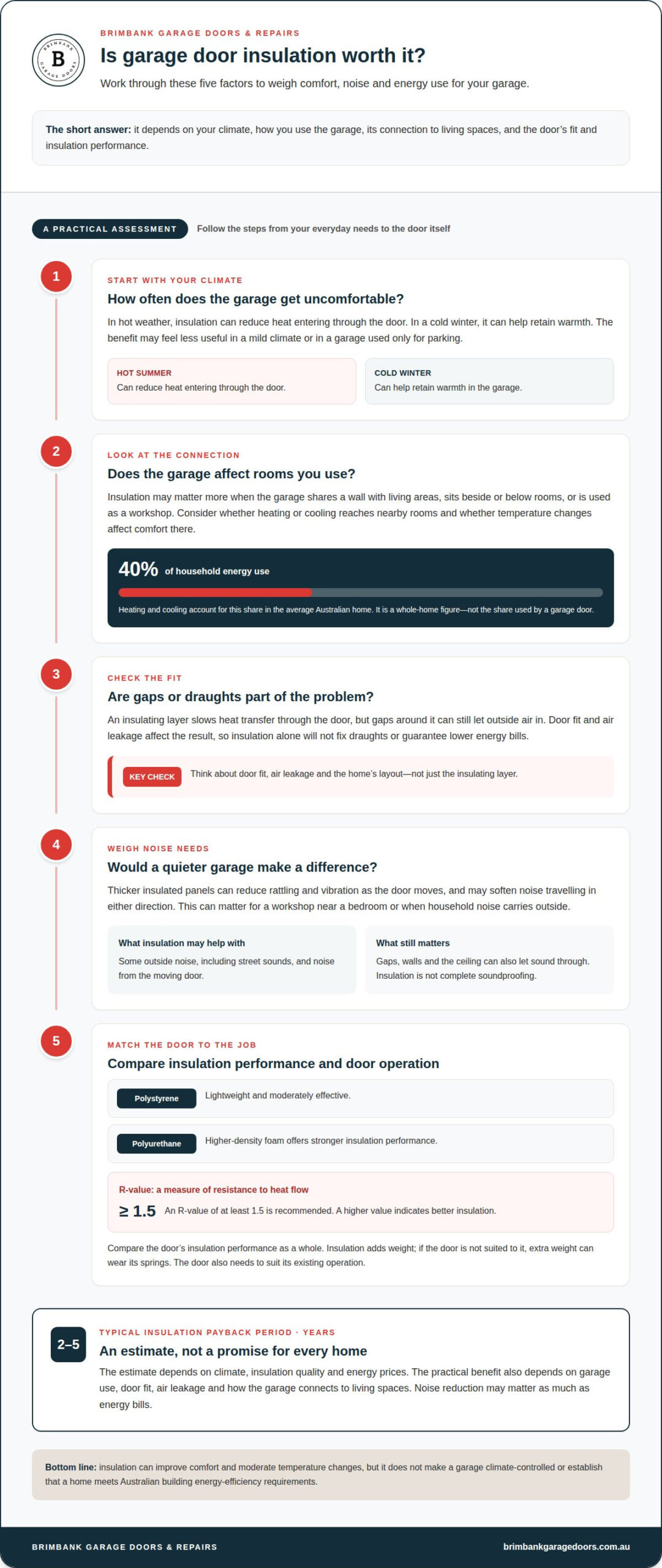
Door insulation supports household efficiency by reducing one route for heat to move between indoors and outdoors. According to the Australian Government Department of Climate Change, Energy, the Environment and, heating and cooling account for 40 per cent of household energy use in the average Australian home. That figure covers the whole home, not the garage door alone. The practical benefit depends on the garage’s connection to living spaces and whether heating or cooling reaches those rooms. For example, a garage beside a conditioned living room can transfer heat through its shared wall as well as its door.
Heating and cooling costs
Energy efficiency can influence heating and cooling costs because equipment may need to run less when indoor temperatures stay more stable. Insulation is one part of the picture, not a guaranteed bill reduction. Climate, door fit, air leakage and the home’s layout all affect the result. A poorly sealed door can still let outside air into the garage, reducing the value of its insulating layer.
There are trade-offs. Insulation adds weight to a door, and extra weight that the door is not suited to can wear its springs. The door also needs to suit its existing operation. When considering an upgrade, think about how you use the garage, whether nearby rooms need temperature control, and whether draughts are present. These details help show where insulation may improve efficiency, rather than assuming every garage will save energy.
Is garage door insulation cost-effective for all climates?
Not equally. Climate, insulation quality and energy prices influence whether the comfort and energy benefits justify the upgrade. A typical insulation payback period is two to five years, depending on these factors. That estimate isn’t a promise for every home, and noise reduction may matter as much as energy bills.
In a hot summer, insulation can reduce heat entering through the door; in a cold winter, it can help retain warmth. The benefit is clearer where the garage connects to a living area or is used as a workshop. In a mild climate, or a garage used only for parking, the temperature difference may feel less useful. Consider how often the space becomes uncomfortable and whether rooms beside or above it are affected.
Noise reduction is another practical benefit. Insulation adds thickness to garage door panels, which can reduce rattling and vibration as the door moves. It can also soften noise travelling in either direction. A quieter garage may matter, for example, if someone uses a workshop near a bedroom or household activity carries into the street.
Insulation can reduce some outside noise, including street sounds, but it isn’t the same as complete soundproofing. Gaps around the door can still let sound through, and noise may also travel through walls or the ceiling. The door’s fit and the surrounding construction therefore affect how much quieter the garage feels. Consider whether the noise comes mainly through the door or from elsewhere.
Climate and noise needs can point to different priorities. A household in a warm region may value reduced heat, while a home beside a busy road may prioritise sound reduction. If replacing a door is part of that decision, garage door installation can be considered alongside the insulation and noise needs of the space.
Will garage door insulation increase my property value?
Insulation doesn’t automatically add a set amount to a home’s sale price. It can improve the garage’s usefulness and energy efficiency, which may strengthen its appeal to homeowners and buyers. A garage used for storage, hobbies or access to living areas has more to gain than one used only for parking. The door’s condition, fit and overall presentation also shape how buyers judge the space.
Temperature changes can affect stored belongings. In summer, heat may be a concern for paint, electrical equipment and other items sensitive to fluctuating conditions; cold weather can also affect stored products. Insulation helps moderate temperature changes through the door, but it doesn’t make the garage climate-controlled. Keep moisture-sensitive items sealed and raised from floors, and maintain ventilation to limit damp air and condensation. Insulation alone does not prevent moisture problems.
Cars and garage components also face seasonal conditions. Cold temperatures can shorten a car battery’s life and thicken engine fluids, while an insulated door can help shield vehicles from cold. A steadier garage environment may also reduce temperature swings around stored tools and equipment. An uninsulated door offers less thermal resistance, so outside conditions can pass through it more readily.
Australian garage doors commonly use polystyrene or polyurethane insulation. Polystyrene panels are lightweight and moderately effective, while higher-density polyurethane foam offers stronger insulation performance. The R-value describes resistance to heat flow: a higher value indicates better insulation, and an R-value of at least 1.5 is recommended. Compare the door’s insulation performance as a whole, rather than assuming the material alone determines its value.
When presenting insulation as a property feature, treat it as a practical improvement, not a guaranteed increase in value. A tidy, well-operating door and a garage that protects belongings and supports everyday use give buyers clearer reasons to appreciate the improvement.
How garage door insulation reduces heat transfer
Insulated garage doors slow heat moving between the garage and the outdoors. Their core acts as a barrier, but construction and door fit both affect performance.
Heat movement through garage doors
Heat moves through a door when energy transfers from a warmer side towards a cooler surface. An insulating core between the outer layers slows this movement, helping retain warmth in winter and limit incoming heat in summer. Many insulated doors use a steel or aluminium shell around polystyrene or polyurethane. The core resists heat flow, while the outer surface still responds to outdoor conditions.
Think of the door as one part of the garage envelope. Heat can also pass through gaps, adjoining walls and the ceiling, so insulation in the panels cannot address every route. For example, a well-insulated door with poor perimeter sealing may still allow draughts. A better fit helps the insulating layer work as intended.
Insulated and non-insulated door differences
A non-insulated door has no insulating core, so its panels provide less resistance to heat moving through the door. Insulated versions add a core between layers, creating a more effective thermal barrier. This can help keep the garage temperature steadier, especially when it shares a wall with living space or stores temperature-sensitive items.
Construction also affects durability and operation. Insulation can add weight, so the door’s springs and balance need to suit its overall build. Sectional doors generally offer stronger insulation options than traditional roller doors, while roller designs can suit garages with limited ceiling space. The right choice depends on door type, available space and how you use the garage.
For energy savings, consider the complete assembly rather than the core alone. Panel insulation, seals, alignment and regular operation all influence heat transfer. A damaged seal or misaligned panel can let outside air through, reducing the barrier’s benefit. In short, insulation slows heat through the door, while a good fit helps limit air leakage.
If you’re considering a new door to improve thermal performance, explore garage door installation for an option suited to your garage.
Brimbank Garage Doors & Repairs
Brimbank Garage Doors & Repairs helps homeowners in Melbourne’s western suburbs consider garage door condition, fit and use when weighing insulation and energy efficiency. If the door is worn, difficult to operate or due for replacement, our installation, repair and maintenance services can address its condition and operation. We also supply garage roller doors for residential properties.
The right next step depends on what the garage needs. An existing door may need attention to operate properly, while a replacement may better suit the space and its everyday use. Considering these practical factors helps you make an informed choice without treating insulation as a guaranteed energy saving or increase in property value.
For help with your garage door, contact Brimbank Garage Doors & Repairs.
Make your next garage door decision with confidence
Turn the insulation question into a clear plan for your home. Consider how you use the garage, whether the existing door operates smoothly, and what you want the space to do next. These priorities help shape a practical decision about the door, rather than focusing on insulation alone. Weigh insulated garage door benefits in Australia against your home’s layout, daily routines and long-term plans.
Brimbank Garage Doors & Repairs provides garage door installation, repairs and maintenance across Melbourne’s western suburbs, taking the door’s condition and operation into account. Tell us what you’re looking to improve, whether that’s comfort, a more functional garage or a door that needs attention.
Contact Brimbank Garage Doors & Repairs to discuss your garage door needs and take a considered next step for your home.
Frequently Asked Questions
Are Insulated Garage Doors Worth the Investment?
Insulation is worth considering if you use the garage as a workspace, it connects directly to living areas or it stores items affected by temperature swings. The case is less compelling for a rarely used, detached garage where temperature control has little practical benefit. Include comfort, noise, door condition and how long you expect to use the home in your decision, rather than judging insulation by energy savings alone.
Does insulation require ongoing maintenance?
The insulating core doesn’t need a separate maintenance routine, but the door still needs care. Look for visible damage or compressed insulation, as these can reduce its effectiveness. Clean the interior surface with a soft cloth and mild detergent. Keep the door’s moving parts operating correctly, too: insulation adds weight, so spring balance and smooth movement matter for reliable operation.
The Verdict: Is It Worth It?
Insulation is worthwhile when a garage’s temperature, comfort or noise affects how you use the space. A home office beside the garage, for instance, may benefit from a more comfortable adjoining area, while a storage-only garage may offer fewer everyday gains. Consider the door’s condition and your intended use together. Insulation is a practical feature, not a standalone guarantee of lower bills or higher resale value.
What are the benefits of an insulated garage door in Australia?
In Australian homes, insulation can help moderate temperature changes, make a garage more comfortable and soften some noise. It can also help protect stored items from sharp temperature fluctuations. These benefits matter most when the garage is used regularly or shares a boundary with occupied rooms. The door’s fit and the garage’s ventilation also affect how useful the upgrade feels day to day.
How much can an insulated garage door reduce heat gain and loss?
High-performance garage door insulation can reduce heat transfer through the door by up to 90%. That figure applies to heat moving through the door, not to total household energy use or energy bills. Actual performance depends on the door assembly and how well it fits. Gaps, adjoining walls and the ceiling remain separate routes for heat transfer.
Do insulated garage doors reduce noise in Australian homes?
Yes, insulation can reduce some noise entering or leaving the garage and may lessen rattling from door panels. This can help when a bedroom or living space is close to the garage, or household activity carries outdoors. It won’t make the space completely soundproof: gaps, walls and ceilings can still transmit noise. The improvement depends on where the sound travels.