
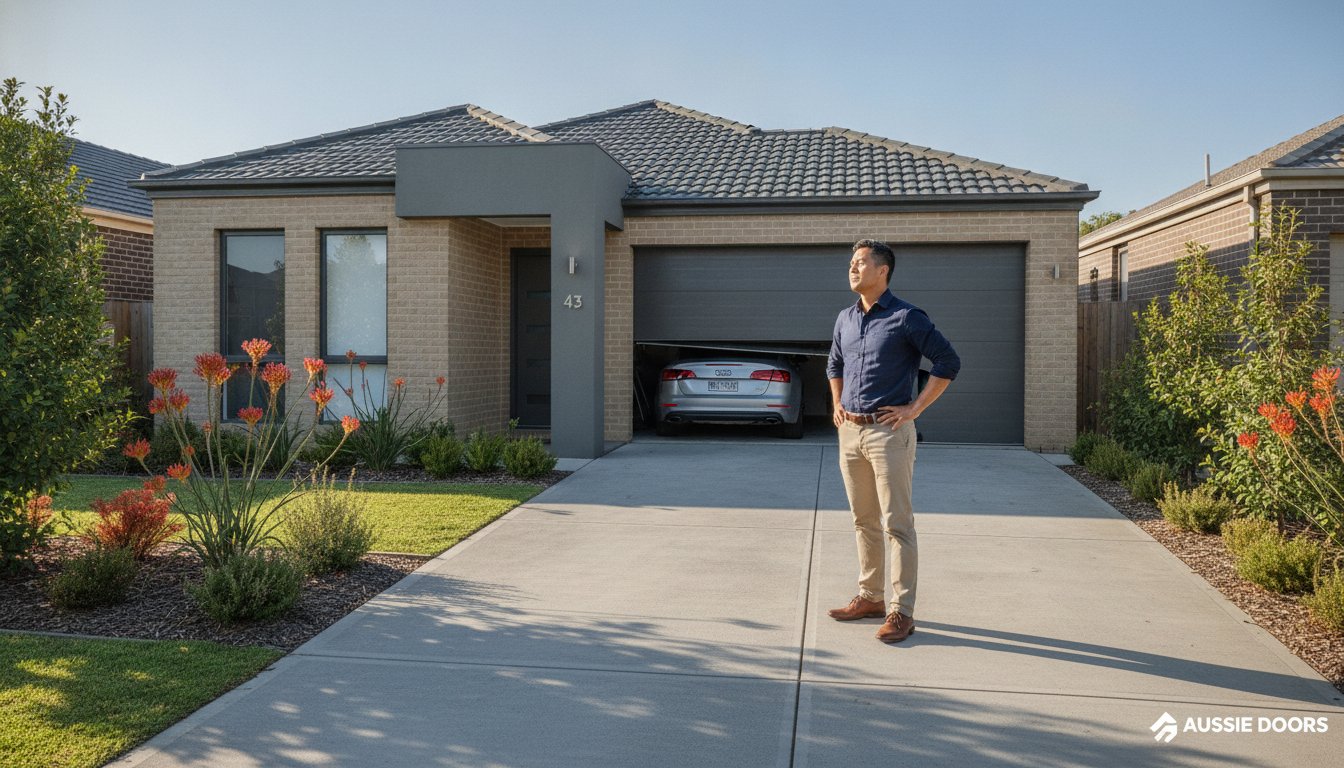
You are already five minutes late for a meeting in the CBD, but as you hit the remote, your garage door won’t open all the way. It shudders, stops, and leaves your car trapped behind a half-closed steel curtain. It is a frustrating start to the morning that raises immediate worries about home security and the potential for a massive repair bill if the motor burns out. Most homeowners feel that same spike of anxiety when their main exit is blocked, especially when they are worried about the safety of their family and belongings.
The good news is that a door stopping halfway is often a safety feature designed to prevent a larger mechanical failure. In this guide, you will discover why your door is behaving this way and learn which simple maintenance tasks you can handle yourself. We will also clarify exactly when it is time to call a local Melbourne specialist, like Matt, to ensure the job is done safely. We are going to preview the five most common culprits, from blocked sensors to tension issues, so you can return to a door that operates smoothly and reliably every single time.
Key Takeaways
- Understand why your door’s “safety reverse” logic triggers a stop to protect the motor from permanent damage and burnout.
- Learn how to check for simple mechanical obstructions or misaligned tracks that often cause a door to halt midway through its cycle.
- Discover why your garage door won’t open all the way when a spring is weakened and why attempting a DIY fix on high-tension springs is a major safety risk.
- Master the “Manual Pull” test to quickly distinguish between a minor electrical glitch and a serious mechanical failure.
- Identify the “10-minute rule” to know exactly when to stop troubleshooting and call a local Melbourne specialist to avoid further damage.
Why Your Garage Door Stops Halfway: Understanding the Logic
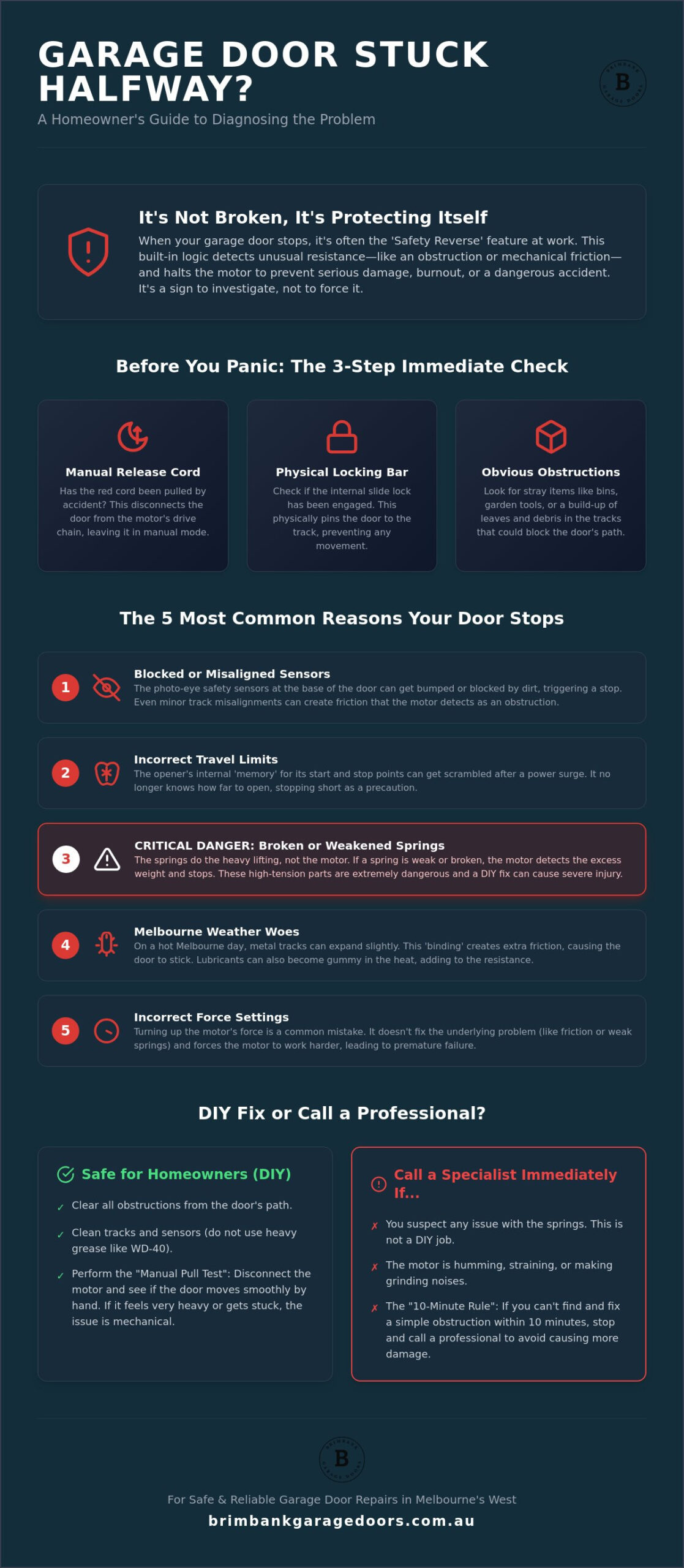
When your garage door won’t open all the way, it is easy to assume the motor has simply given up. Most of the time, the opposite is true. The system is actually working exactly as designed. Modern units are programmed with a “safety reverse” or “resistance logic” that acts as a fail-safe. If the door detects even a slight hiccup in its travel, it stops to prevent crushing an object or snapping a cable. This protection is a core feature of a modern electric garage door opener, ensuring that a minor mechanical issue doesn’t turn into a dangerous accident.
Understanding the “brain” of your opener is the first step toward a fix. You need to determine if you are dealing with a simple electrical glitch or a physical mechanical jam. An electrical glitch might involve a sensor being bumped out of alignment or a limit switch losing its memory. A jam, however, suggests something is physically blocking the rollers or the tracks. Ignoring these signals and repeatedly hitting the remote button can drastically shorten your motor’s lifespan. You are essentially asking a machine to do the impossible; this leads to stripped gears, snapped belts, and burnt-out circuit boards.
Before diving into complex repairs, perform a quick “sanity check” to rule out the basics. Check these three things first:
- Ensure the manual release cord hasn’t been pulled by accident, leaving the door disconnected from the drive.
- Check that the physical locking bar hasn’t been engaged, which physically pins the door to the track.
- Look for obvious obstructions like a stray garden tool, a child’s toy, or a build-up of debris in the tracks.
The Role of the Opener’s Force Settings
The opener has internal settings that dictate how much “muscle” it uses to lift the door. If the door feels heavier than expected due to a lack of maintenance, the motor cuts power. Some people try to bypass this by turning up the force settings on the motor head. This is a mistake. Increasing the force doesn’t fix the underlying friction; it just forces the motor to work harder until it eventually fails. If you hear the motor straining or humming without moving the door, it is struggling against a physical weight it cannot handle safely.
Melbourne Weather and Metal Expansion
Residents in Melbourne’s West, from Sunbury to Caroline Springs, know how quickly the temperature can spike. Extreme heat causes the metal tracks and the door itself to expand slightly. This expansion can lead to “binding,” where the door becomes too tight for the guides. Additionally, the lubricant used on roller door guides can dry out or become “gummy” in the heat. If your garage door won’t open all the way during a 35-degree afternoon but works fine in the cool morning air, temperature-related expansion is the likely culprit.
Common Culprits: From Travel Limits to Track Issues
When your garage door won’t open all the way and consistently halts at the exact same height, the problem is frequently invisible to the naked eye. While many homeowners immediately fear a mechanical breakdown, the issue often lies within the “memory” of the motor unit. These settings, known as travel limits, dictate the precise start and stop points for the door’s journey. If these boundaries are even slightly out of alignment, the system will stop short to avoid what it perceives as an over-extension or a collision risk.
It is also vital to distinguish between the sectional doors common in overseas DIY videos and the roller doors found in most Melbourne driveways. In Australia, roller doors rely on side guides that run the full height of the opening. A small “ding” from a car bumper or a shifted brick can narrow these guides, creating a pinch point. Unlike a major obstruction, these small misalignments cause just enough friction to trigger the safety reverse logic we discussed earlier. Regular garage door maintenance can identify these subtle track shifts before they put undue strain on your motor.
Adjusting Your Travel Limits
Most modern openers feature limit adjustment screws or digital buttons located on the side or rear of the motor housing. These are usually marked with “up” and “down” arrows. Recalibrating them is often a matter of trial and error; you turn the screw in small increments and test the door after each adjustment. However, if you find your limits are “lost” frequently, it might be a sign of a failing circuit board or the aftermath of a local power surge. In these cases, a simple reset won’t provide a long-term fix.
Inspecting the Tracks and Guides
Clean tracks are essential for a smooth operation. Many people make the mistake of spraying heavy grease or WD-40 into the guides, but this actually attracts dust and grit, creating a thick paste that jams the rollers. Instead, use a damp cloth or a small amount of methylated spirits to wipe away debris. Check the vertical alignment of the tracks with a spirit level. If the tracks have vibrated loose from the wall, the door will bind as it rises, causing it to stop halfway to protect the motor from burning out.
While you are inspecting the tracks, take a look at the rollers and the “photo-eye” sensors. Although sensors usually prevent a door from closing, a flickering light or a loose wire can occasionally disrupt the opening cycle on certain models. If the rollers are flat-spotted or no longer spin freely, they become a significant bottleneck. These small wheels should glide, not slide. If they are dragging, the increased resistance will convince the opener that the door has hit an obstacle, causing it to shut down prematurely.
The Critical Danger: Broken or Weakened Springs
Most homeowners assume the motor is the muscle of the system. In reality, the motor is just the brain that guides the movement. The actual heavy lifting is performed by the springs. These components are under immense tension, designed to counterbalance the full weight of the door so it feels light enough to move. If your garage door won’t open all the way, it is often because the motor has encountered a weight it simply cannot manage. When a spring snaps or loses its tension, the door effectively becomes a dead weight of 80 to 120 kilograms.
A halfway stop is a classic symptom of a snapped torsion spring. The motor might manage to grunt and heave the door up the first metre, but as the physics of the lift change, the resistance becomes too great. You can usually spot this issue by looking at the metal bar above your door. A broken torsion spring will have a visible gap of two to five centimetres where the coil has separated. If you see this, stop trying to use the opener immediately. Forcing the motor to lift a door with a broken spring is the fastest way to turn a standard repair into a total motor replacement.
Why You Should Never DIY Spring Repairs
The physics of spring tension are unforgiving. These springs store enough energy to cause severe injury or property damage if they release unexpectedly. Professional garage door spring replacement western suburbs requires specialised winding bars and technical training to manage this kickback risk. A DIY attempt often results in the door crashing down unexpectedly or the winding bar slipping, which can lead to hospitalisation. It is one of the few garage tasks where the risk to your safety far outweighs the cost of a professional call-out.
Signs of ‘Fatigued’ Springs
Springs don’t always fail with a bang, though a loud shotgun noise from the garage is a common report from residents in Sunbury and Caroline Springs. Sometimes they just get tired. Rust is the primary enemy here; it creates friction between the coils and weakens the steel. If your garage door won’t open all the way and feels incredibly heavy when you pull the manual release cord, your springs are likely fatigued. You can perform a safe “Balance Test” by lifting the door halfway by hand while the motor is disconnected. A healthy door should stay in place or move very slowly. If it crashes to the floor, your springs are no longer doing their job and need urgent attention from a specialist.
Step-by-Step Troubleshooting Guide for Homeowners
Before you start poking around the mechanical parts of your system, safety is the absolute priority. Always disconnect the power to the motor unit to prevent it from activating while your hands are near the tracks or rollers. Once the power is off, the most effective diagnostic tool at your disposal is the “Manual Pull” test. Pull the emergency release cord, which is usually the red rope, and attempt to lift the door by hand. If you can lift it easily to the full height, the reason your garage door won’t open all the way is likely related to the motor settings or travel limits. If the door feels incredibly heavy or jams halfway even when you are pulling it, the problem is physical.
While you are moving the door manually, perform a visual inspection of the cables and pulleys. Look for any signs of fraying, rust, or tangles around the drum. If a cable has jumped its track, it will create an uneven lift that triggers the motor’s safety reverse. You can also perform a “trolley check” by running the motor while the door is still disconnected. If the trolley travels the full distance along the rail without stopping, your motor and limits are likely functioning correctly. If you notice any damage to the cables or the motor continues to struggle, it is time to book professional garage door repairs to avoid further damage to the system.
Step 1: Check for Obstructions
Begin by clearing the tracks of common debris like thick cobwebs, dried leaves, or small stones that can accumulate in the guides. It is also vital to check the top of the roller door drum. Sometimes, items stored on high garage shelves can shift and fall onto the drum, blocking the door as it tries to roll up. Ensure no bikes, garden tools, or ladders are leaning against the side tracks, as even a small amount of lateral pressure can cause the rollers to bind and stop the cycle.
Step 2: Lubricate the Right Parts
Friction is a silent motor killer. Apply a high-quality silicone-based spray to the rollers and hinges to keep the movement fluid and reduce the load on your opener. Never use thick grease or oil inside the tracks; as we have discussed, this only attracts grit and creates a sticky paste that eventually leads to more jams. Listen for a reduction in squeaks or grinding sounds after application. If the door suddenly moves more freely, you have likely solved a resistance issue that was confusing the motor’s sensors.
Step 3: Reset the Opener
Sometimes the internal logic of the opener just needs a fresh start. Perform a “hard reset” by unplugging the motor from the wall socket for at least 30 seconds before plugging it back in. This can clear minor software glitches. You should also check your remote battery; a weak signal can sometimes cause the door to stop and start intermittently, giving the impression that the garage door won’t open all the way. Finally, follow your manufacturer’s guide to re-learn the travel limits if the door continues to stop at the wrong height.
When to Call a Professional in Melbourne’s West
If you have spent ten minutes troubleshooting and your garage door won’t open all the way, it is time to put the tools down. We call this the “10-Minute Rule.” While the DIY steps we have covered can solve minor glitches, persistent resistance usually points to a failing component that requires specialised tools to rectify safely. Continuing to hit the remote button when the door is struggling is the fastest way to cook your motor. A replacement motor is a significantly higher expense than a standard service call; stopping early is the best way to protect your hip pocket.
Forcing a stuck door is a recipe for disaster. If a roller is jammed or a cable is tangled, the motor’s force can actually bend the internal axle or snap the lifting cables entirely. At Brimbank Garage Doors & Repairs, Matt specialises in identifying these high-pressure faults before they cause a total system collapse. Investing in a professional roller door service ensures that every part of the system, from the spring tension to the guide alignment, is calibrated to Australian safety standards. This is particularly important for residents in Sunbury, Keilor, and Caroline Springs, where local weather conditions can put extra strain on residential doors.
Protecting Your Home Security
A garage door that won’t open all the way often has trouble closing securely too. This creates a massive vulnerability for your home. Even a small gap at the bottom of the door can be used as leverage by opportunistic thieves, or it may simply fail to engage the electronic lock properly. You don’t want to be “limping” along with a faulty door when the Melbourne winter hits. Getting a reliable repair now means you won’t be left with a door that refuses to close in the middle of a storm, leaving your cars and workshop tools exposed to the elements and intruders.
Direct Service, No Sales Pressure
One of the biggest benefits of calling a local specialist is the direct communication. When you call Brimbank Garage Doors & Repairs, you deal directly with Matt, not a call centre or a franchise salesman. This means you get transparent, honest advice on whether your door needs a simple adjustment or if it’s time to consider a replacement. There are no high-pressure sales tactics; just a focus on getting your door back to a smooth, reliable operation. If your garage door won’t open all the way despite your best efforts, reach out for a solution that prioritises your home’s safety and your peace of mind. Book a reliable repair with Matt today and get your garage back in working order.
Restore Your Home’s Security and Smooth Operation
Identifying why your garage door won’t open all the way is the first step toward a permanent fix and a safer home. Whether the issue is a simple limit switch adjustment or a physical track obstruction, catching these problems early prevents a total motor burnout. While basic maintenance like cleaning tracks is a great DIY task, remember that high-tension components like springs are dangerous and require professional handling. Taking the time to understand the logic of your opener saves you from costly mechanical failures down the road.
Matt at Brimbank Garage Doors & Repairs has provided expert residential roller door repairs across Melbourne’s West for years. You can count on no-fuss, honest local service that prioritises your family’s security and your peace of mind. Dealing directly with a local specialist means you get transparent advice without the sales pressure of a large franchise. It is about getting the job done right so your door lasts through the toughest Melbourne winters.
Don’t let a stubborn door trap your car or leave your home vulnerable. Get your garage door moving again; Contact Matt for a Reliable Repair today. We are ready to help you return to a door that operates smoothly and reliably every single time.
Frequently Asked Questions
Why does my garage door start to open and then stop?
Your door stops because its internal safety logic detects resistance that it cannot overcome. This is a protective feature designed to prevent the motor from burning out or causing an accident. If the door encounters a physical obstruction, a bent track, or a lack of lubrication, the system halts the cycle to avoid serious mechanical damage.
Can I manually open my garage door if it’s stuck halfway?
You can manually open the door by pulling the red emergency release cord to disconnect it from the motor. However, you must be extremely cautious. If a garage door won’t open all the way because of a broken spring, the door will be incredibly heavy and could crash down unexpectedly. Always test the weight of the door carefully before attempting to lift it to the top.
How do I know if my garage door spring is broken?
The most obvious sign of a broken spring is a visible gap of several centimetres in the coil of the torsion spring above the door. You might also notice the door feels impossible to lift by hand or that the motor grunts but cannot move the door. Many homeowners also report hearing a loud bang, similar to a gunshot, coming from the garage when a spring snaps under tension.
Is it safe to adjust the travel limits myself?
Adjusting the travel limits is generally a safe task for homeowners to handle if they follow the specific instructions in their manufacturer’s manual. Most modern openers use simple screws or digital buttons to recalibrate the start and stop points. If you find the door consistently “forgets” its limits even after adjustment, there may be an underlying electrical fault or a failing circuit board that needs professional attention.
Will a garage door stop opening if the sensors are dirty?
Safety sensors are primarily designed to prevent a door from closing on an obstruction, but a flickering signal can occasionally disrupt the opening cycle on certain models. Dust, cobwebs, or even direct sunlight hitting the sensor lens can cause the system to behave erratically. Wiping the lenses with a clean, soft cloth is a quick and easy way to rule out sensor interference.
How much does it cost to fix a garage door that won’t open?
The cost of a repair depends entirely on the root cause, such as whether you need a simple limit reset, a track alignment, or a spring replacement. While minor adjustments are a standard service, ignoring these early warning signs can lead to motor failure, which is a much more expensive problem to solve. A local specialist can provide an honest assessment and a transparent quote once they have inspected the mechanical components.
What should I do if I hear a grinding noise when the door stops?
Stop using the opener immediately if you hear grinding, screeching, or heavy vibration. This sound typically indicates that the internal gears are stripped or that the rollers are dragging against a misaligned track. Continuing to hit the remote button while the system is grinding will cause permanent damage to the drive assembly and will likely result in a total motor replacement.
Does Melbourne’s heat affect how my garage door opens?
Extreme heat in Melbourne’s West causes the metal tracks and the door curtain to expand slightly. This expansion creates “binding” in the side guides, increasing the resistance the motor has to fight against. If your door hasn’t been lubricated recently, this extra friction can be enough to trigger the safety reverse logic, causing the door to stall during the hottest part of the afternoon.