
If your garage door remote is not working in Melbourne, the remote itself may not be the cause. When the door won’t open or close, it’s easy to suspect a flat battery or faulty opener, but the problem could be elsewhere in the signal-to-door chain.
It’s frustrating to be stuck outside or worry that your garage isn’t secure, especially when you’re unsure what’s safe to check. Start with the simple possibilities. This guide covers practical checks for the remote battery, range and signal, then helps you look for signs of an opener power issue or a problem with the door itself. You won’t need to dismantle equipment or go near moving parts.
By the end, you’ll have a clearer idea of what the symptoms may point to and when it’s time to arrange a repair. If the basic checks don’t resolve the issue, a local assessment can help identify the fault. Brimbank Garage Doors & Repairs provides residential garage door repairs across Melbourne’s western and northern suburbs.
Key Takeaways
- Trace the fault from remote to receiver, opener and door before assuming a part needs replacing.
- Start with simple, safe observations and use the wall control, if fitted, to help narrow down the issue.
- For a garage door remote not working in Melbourne, treat symptoms as clues only. They can’t confirm the cause on their own.
- Don’t dismantle the opener, alter wiring or work on springs and moving parts while troubleshooting.
- Note how the remote behaves, whether the wall control works and any visible door symptoms before arranging a local repair assessment.
Garage door remote not working in Melbourne? Understand the fault path
A remote that suddenly stops opening the garage can disrupt your routine and leave you wondering whether the door is secure. But a failed button press doesn’t automatically mean the opener has packed it in. The remote is a transmitter: when you press its button, it sends a signal to a receiver associated with the garage door opener. For the door to move, the receiver must respond and the opener must be able to operate the door.
There are several points to consider before blaming one part. The remote may not be transmitting as expected, the receiver may not be responding, the opener may lack power, or the door system may not be able to operate safely. These are possibilities, not a diagnosis. If you’re searching for “garage door remote not working melbourne”, understanding the chain helps you make sense of what you observe without jumping straight to a replacement.
How the remote, receiver and opener work together
Pressing the remote sends a coded radio signal towards the opener’s receiver. Depending on the door system, the receiver may be built into the opener or connected separately. If the receiver recognises the signal, the opener can respond, provided it has power and its safety conditions allow the door to move. Designs and settings vary, so not every remote or opener works in exactly the same way.
In simple terms, the remote requests movement; it doesn’t lift the door itself. The receiver picks up the request, and the opener operates the door if the system can respond. The Garage Door Opener Overview provides further background on opener components and how these systems developed.
What a failed remote can look like
If one remote stops working but another still opens the door, the fault may be limited to that remote or its connection to the opener. If several remotes stop operating the door around the same time, the issue may be with a shared part of the chain, such as the receiver, opener power or the door system. Neither pattern confirms the cause on its own.
Inconsistent operation can also have more than one possible explanation. A remote may work from one spot but not another, or respond only some of the time. That behaviour could relate to the remote, the signal path or the opener’s response, so don’t treat it as proof that a particular component has failed.
Quotable summary: The remote sends a coded signal, the receiver passes a recognised request to the opener, and the opener moves the door only when it can operate safely.
Keeping that sequence in mind makes the next checks more useful. Notice whether the problem affects one remote or all of them, and whether the door responds through another control. Those clues help narrow the fault path before you decide what to do next.
How to troubleshoot a garage door remote safely, step by step
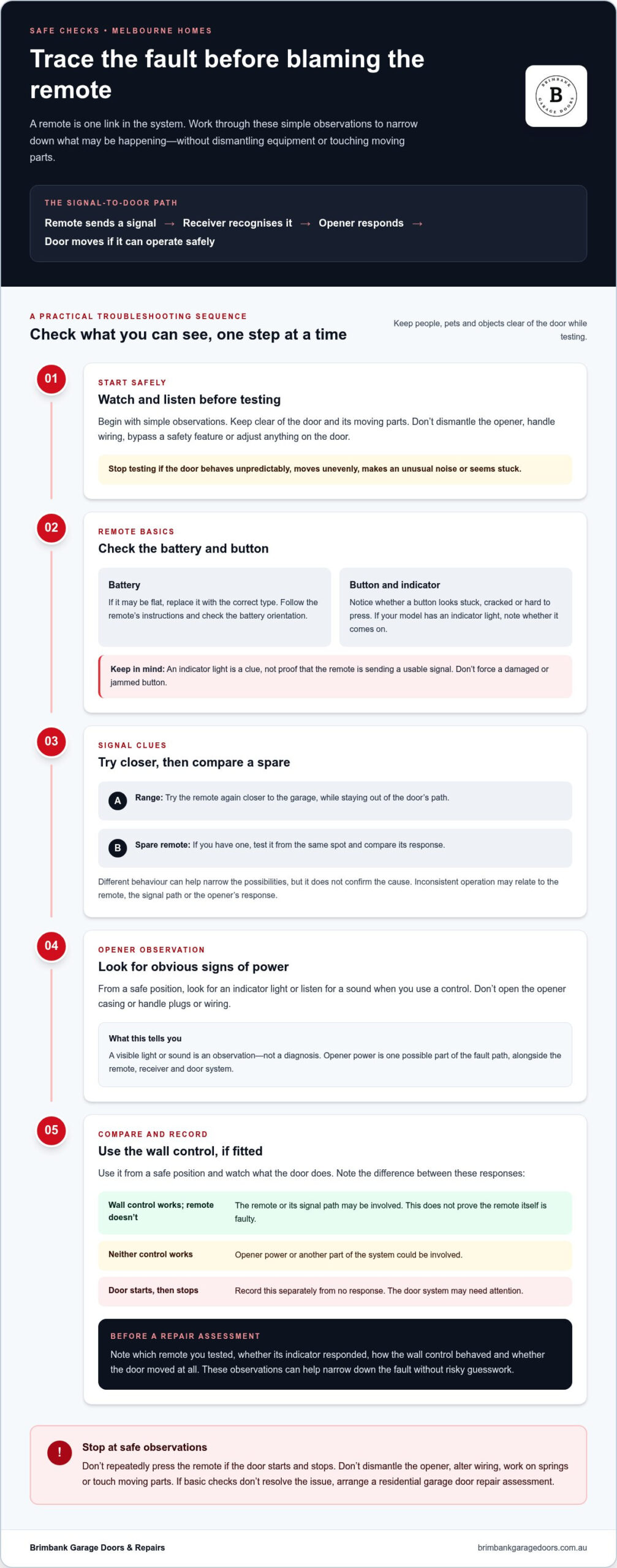
Start with what you can see and observe. You don’t need to remove the opener cover, handle wiring or touch the door’s springs to gather useful clues. If you’re dealing with a garage door remote not working in Melbourne, work through these checks in order and stop if the door behaves unpredictably. Keep people, pets and objects clear of the door while testing it.
Check the remote battery, buttons and range
Begin with the remote. Look for a button that appears stuck, cracked or difficult to press, and note whether an indicator light comes on if your model has one. A light is only a clue, not proof that the remote is sending a usable signal. Follow the remote’s instructions when checking or replacing its battery.
- Battery: Replace a flat battery with the correct type, following the remote’s instructions and paying attention to its orientation.
- Button: Press it normally. Don’t force a damaged or jammed button.
- Range: Try again closer to the garage, without standing in the door’s path.
- Spare remote: If you have one, compare its response from the same spot. Different behaviour is a useful clue, not a definite diagnosis.
Check power and compare the controls
Next, look for obvious signs the opener has power, such as an indicator light or a sound when you use a control. Don’t open its casing or handle plugs or wiring. If a wall control is fitted, use it from a safe position and watch what the door does. A response narrows the possibilities, but it doesn’t prove the remote is faulty.
- Wall control works, remote doesn’t: Note the difference. The remote or its signal path may be involved.
- Neither control works: The opener’s power or another part of the system could be involved.
- Door starts, then stops: Record this separately from no response. It may indicate the door system needs attention, rather than a remote that simply isn’t communicating.
Keep the test simple. Don’t repeatedly press the remote if the door starts and stops, and don’t try to bypass a safety feature or adjust anything on the door. Garage door safety features are there to help reduce risks during operation; you can read more in this Garage Door Safety Features overview. If the door moves unevenly, makes an unusual noise or seems stuck, stop testing and keep clear.
Before arranging a repair, note which remote you tested, whether its indicator responded, how the wall control behaved and whether the door moved at all. Those observations can help narrow down the fault without risky guesswork. If the checks don’t resolve the issue, a residential garage door repair assessment is a sensible next step for homes across Melbourne’s western and northern suburbs.
Remote symptoms compared: what may be behind each problem?
The way a remote behaves can help narrow down where to look, but it can’t confirm which component has failed. Compare the remote with any other available control, then note exactly what the door does. These are clues, not a diagnosis. If you’re researching “garage door remote not working melbourne”, use the patterns below to guide safe observations rather than replacing parts on a guess.
| Symptom | Possible area to check | Safe next step |
|---|---|---|
| One remote fails, but a spare or wall control works | The affected remote, its battery or its signal to the opener could be involved. | Check the remote’s battery, button and range. Compare it with the working control. |
| Several controls fail to operate the door | The opener’s visible power status or a wider part of the door system may need attention. | Look for obvious signs of power without opening the opener casing. Note whether any control gets a response. |
| The remote works intermittently | The remote, signal path or opener response could be inconsistent. | Record where you’re standing, when it works and any changes in behaviour. Avoid repeated pressing if the door responds unpredictably. |
| The door starts, stops or reverses instead of completing its movement | This may involve a separate safety or operating issue, not simply a remote fault. | Stop testing if movement seems unusual, keep clear of the door and arrange an assessment. |
One remote fails, but another control works
If a spare remote operates the door while the original does not, begin with the original’s battery, buttons and range. A spare that works shifts attention towards the individual remote or its connection, but it doesn’t prove that the remote itself is faulty. Some systems may also need a remote to be paired with the opener. Instructions vary by make and model, so don’t follow generic pairing steps without checking the correct guidance. The Programming a Garage Door Remote guide offers an example of why setup steps are specific to the equipment.
No controls work, or the door responds inconsistently
If the remote and wall control both fail, note any visible opener lights or sounds, but don’t open the casing or touch wiring. For intermittent operation, record the distance from the garage, the time of each attempt and whether another control behaves differently. This gives a clearer picture than simply reporting that the remote sometimes works.
Comparing controls narrows down where to look, but only an assessment can establish what has actually failed. A door that stops or reverses deserves particular care: don’t assume a new remote or pairing will resolve it. If the door behaves unexpectedly, stop using the controls and keep people clear until the issue is assessed.
When should you stop DIY checks and arrange a garage door repair?
A remote problem doesn’t always call for another remote. Replacing one or trying to pair it again may not help if the issue lies with the receiver, opener or door itself. A search for “garage door remote not working melbourne” can lead to quick fixes, but stop troubleshooting if the door is damaged, jammed or behaving unpredictably. The priority is keeping people clear and avoiding actions that could make the fault worse.
Warning signs that call for a professional assessment
Stop operating the door if you notice visible damage, grinding or other unusual noises, uneven movement, or a door that seems stuck. Don’t stand beneath it or let children and pets near it. Springs and other loaded components can store force and are dangerous to handle, even if the fault appears small.
- Unusual movement: Stop if the door jerks, drops, catches or reverses unexpectedly.
- Noise or visible damage: Don’t keep testing a door that grinds, looks damaged or has a component out of place.
- Jammed door: Don’t force it open or closed, or try to lift it yourself.
- Opener or wiring: Don’t dismantle the opener, alter wiring or reach inside its casing.
These signs may point to a door or operating issue that a remote replacement won’t address. For broader context on issues affecting roller doors, see this guide to roller door repairs in Melbourne.
Why repeated resets or remote replacements may not help
Repeating resets or pairing attempts without noting what happens can make the original symptoms harder to describe. Programming steps differ between systems, so a generic procedure may not suit your opener. If basic, safe checks haven’t resolved the problem, pause rather than buying another remote or experimenting with settings.
Before arranging help, record the useful details: which controls you tried, whether the door responded, any unusual movement or sounds, and whether the problem is constant or intermittent. This gives a repair assessment a clearer starting point and helps distinguish a remote issue from a wider operating fault. Don’t keep testing if the door is unsafe to use.
If the issue persists, arrange a residential garage door repair assessment with Brimbank Garage Doors & Repairs. The team provides residential repairs across Melbourne’s western and northern suburbs, helping identify the fault and the appropriate next step for your garage door.
Getting help with a garage door remote issue in Melbourne’s west
If basic checks haven’t solved the problem, a clear account of what you’ve observed can make a repair assessment more useful. A remote that appears faulty may be only one part of the issue. The assessment should consider how the door behaves and how its other controls respond, rather than assuming the remote is the sole cause.
What to note before arranging a repair
Jot down the details while they’re fresh. Note whether one remote or every control fails, whether a wall control works, and whether the door stays still, starts and stops, or moves unevenly. Include when the issue began and any unusual sounds or visible changes. These observations are helpful clues, not a guaranteed diagnosis; the assessment determines what repair is needed.
- Remote behaviour: Does its indicator light respond, and does its behaviour change closer to the garage?
- Other controls: Does a spare remote or fitted wall control operate the door?
- Door symptoms: Does it make an unusual sound, hesitate, stop or reverse?
- Timing: When did the fault start, and has its behaviour changed since?
You don’t need to dismantle equipment or test wiring to explain what’s happening. If the door is jammed or moving unpredictably, stop operating it and keep people clear. A short written note is often more useful than trying extra resets that may change the symptoms before they can be assessed.
A clear next step for Melbourne homeowners
For a garage door remote not working melbourne issue that persists after straightforward checks, Brimbank Garage Doors & Repairs provides residential garage door repairs across Melbourne’s western and northern suburbs. A local repair assessment can consider the remote, opener and visible door behaviour together, then establish the appropriate next step. Share what you’ve noticed, and the assessment can start with those practical details.
Once the immediate problem has been addressed, regular care can help you keep an eye on the door’s condition and operation. Use this garage door maintenance checklist as a practical reference for ongoing upkeep.
If the remote issue remains unresolved, arrange a residential garage door repair with Brimbank Garage Doors & Repairs. Share your notes about the controls and door symptoms so the assessment has a useful starting point.
Get your garage access working reliably again
A garage door remote not working in Melbourne can be a small fault or a sign that the door system needs attention. Treat the remote as one part of your home’s access and security, rather than continuing to replace parts until something works. If the door itself is also due for attention, Brimbank Garage Doors & Repairs supplies and fits garage roller doors and replacement springs alongside residential repairs.
Share what you’ve observed and let an assessment establish where the problem lies. You don’t need to work out the cause first. The appropriate repair can help restore dependable access and give you greater confidence in the security of your garage.
Arrange a residential garage door repair with Brimbank Garage Doors & Repairs. Share what you’ve noticed and take the next step towards getting your garage door working reliably again.
Frequently Asked Questions
Why is my garage door remote not working even after changing the battery?
A new battery won’t fix every remote problem. Check that it’s the correct type and seated with the positive and negative ends oriented as shown in the remote’s instructions. If the case doesn’t close properly or the button feels loose or stuck, the remote may be damaged. A spare remote can help you compare behaviour. If neither remote works, the issue may be elsewhere in the system.
Can I open my garage door if the remote has stopped working?
You may be able to use a wall control, if one is fitted and the opener has power. Some systems also have a manual release for operating the door during a power outage. Only use it as described in the door or opener instructions, and don’t attempt this if the door is jammed, damaged or unusually heavy. A door with a possible spring fault may be unsafe to lift manually.
How do I know whether the problem is the remote or the garage door opener?
Compare controls without dismantling anything. If a wall control or spare remote operates the door but one remote doesn’t, the affected remote may be the issue. If no controls work, the opener or another part of the system could be involved. For example, a light or sound from the opener may show it has power, but it doesn’t confirm that the opener is functioning correctly.
Can a power outage stop a garage door remote from working?
Yes. During a power outage, a powered opener generally can’t move the door, even if the remote is transmitting correctly. Once power returns, check whether the opener responds to its usual controls. If it doesn’t, avoid repeatedly changing settings or attempting unfamiliar reset steps, as procedures vary between systems. Note what happened and consult the opener’s instructions or arrange an assessment if normal operation doesn’t return.
Why does my garage door remote work only when I am close to the door?
A short operating range can have several possible causes, including a weak battery, interference or an issue with the remote or receiver. Try the remote from a few safe positions and note where it works, keeping clear of the moving door. If a fresh, correctly fitted battery makes no difference, don’t open the opener to inspect its receiver. Brimbank Garage Doors & Repairs can assess the signal path and equipment as part of a residential garage door repair.
Is it safe to keep using a garage door that responds intermittently?
Not if its movement is unpredictable. A door that hesitates, stops, reverses unexpectedly or makes a new noise may have an operating or safety issue beyond the remote. Stop testing it and keep children, pets and other people clear. Don’t force the door or try to adjust springs, cables or other loaded components. Arrange an assessment before relying on the door for secure access.
When should I arrange a garage door repair in Melbourne for a remote problem?
Arrange a repair if simple checks haven’t restored reliable operation, several controls fail, or the door itself moves abnormally. If your search is for “garage door remote not working melbourne”, remember that the remote may not be the only cause. Brimbank Garage Doors & Repairs handles residential garage door repairs across Melbourne’s western and northern suburbs. Share what you observed so the assessment can consider the door’s behaviour as well as the remote.