
A garage door that won’t move doesn’t automatically mean the opener motor has failed. To work out how to know if your garage door opener is broken, check whether it has power, test the wall button and remote, then see whether the door moves smoothly by hand when safely disengaged. If the motor runs but the door stays put, a problem with the door’s springs, cables or drive system may be to blame instead.
It’s frustrating when you can’t get in or out as usual, but a few careful checks can help narrow down the cause before you decide what to do next. This guide explains how to assess the opener, distinguish an opener fault from a door problem, and consider repair or replacement. It also explains when to stop testing and keep clear, especially if the door feels unusually heavy, looks unstable or has a damaged spring or cable.
Key Takeaways
- Check the opener’s power supply and remote batteries before treating an unresponsive motor as a failure.
- Use the wall button to help distinguish a remote problem from an opener fault, and reset the opener by unplugging and reconnecting it.
- With the door closed, disengage the opener and check whether the door moves smoothly by hand. Stop if it feels unusually heavy or looks unstable.
- Grinding noises can point to a worn drive gear, while a motor that runs without moving the door may indicate a door or drive-system problem.
- A well-maintained opener typically lasts 10 to 15 years; age, fault type and the condition of the unit can help guide a repair-or-replacement decision.
Is My Garage Door Opener Motor Broken?
A failed motor is only one possible reason a garage door won’t respond. If you’re searching “how to know if garage door opener is broken”, start by checking power, controls and warning signals before suspecting the motor.
1. Check the power supply and backup battery
After a power outage, inspect the opener’s power connection and check your switchboard for a tripped circuit breaker. Unplug the unit, reconnect it, then test the wall switch. If the opener has power but still won’t respond, check its backup battery, if fitted.
A sealed-lead backup battery below 11.5 V can contribute to opener failure. If the backup battery appears weak or is not holding charge, consider having it checked or replaced. A charging voltage of 13.0–13.5 V is the expected range. Avoid opening the motor housing or handling wiring if you’re unsure how to do so safely.
2. Test remote batteries and programming
Replace a weak remote battery, then test the remote close to the garage door. A coin-cell battery below 2.8 V may stop the remote working. If one remote needs a new battery, replace the batteries in all remotes for consistent performance.
Test reliable operation from 20 m away. If the remote works only within 2–3 m, its battery may be weak or the signal may be affected. If fresh batteries don’t help, check that the remote is programmed to the opener. Test the wall switch as well: if it works, the remote or its programming is more likely at fault. This comparison helps narrow down how to know if garage door opener is broken.
3. Check smartphone controls
Open the garage door app and check that your phone has power, an internet connection and access to the opener. If the app responds but the door doesn’t move, try the wall switch to compare. This can help distinguish a phone or connection issue from an opener fault.
After a power interruption, allow the opener to return to normal operation before relying on app controls. If it has a backup battery, check its condition too. An app can’t restore power to an opener that has lost its mains supply and has no working backup.
4. Read flashing lights and error codes
Inspect the opener’s lights or display, then look up any code in the model’s manual. A flashing pattern or code may indicate a safety sensor, travel setting, remote or system fault; its meaning varies by opener. Note the pattern before resetting the unit so you can compare it with the manual’s troubleshooting instructions.
To test the safety sensors, check that nothing blocks them and that their indicator lights are on. Never disable them. A commonly recommended automatic-reverse test uses a 2×4 board laid flat beneath the door; the door should reverse when it contacts the board.
If the opener stops working, you can usually disconnect it using the manual release cord. Keep the door closed first, and don’t try to move it by hand if it feels unusually heavy or unstable.
Checking whether the garage door itself is causing the problem
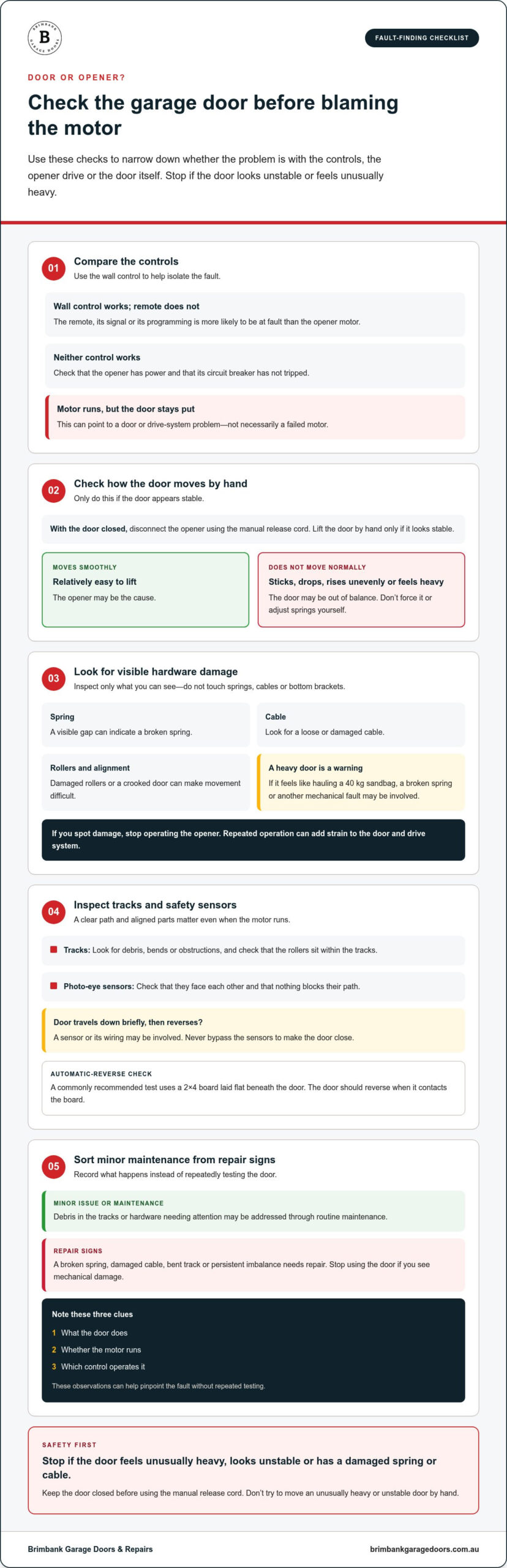
To troubleshoot an opener that won’t open or close, compare the wall control’s response with the door’s movement, then inspect the door’s balance, tracks and safety sensors. If the door feels heavy, looks unstable or has a damaged cable, stop operating it.
-
1. Use the wall control to isolate the fault
Press the wall control and observe what happens. If it operates the door but the remote doesn’t, the fault is more likely to be in the remote or its signal than in the opener motor. If neither control works, check that the opener has power and its circuit hasn’t tripped. Listen carefully: a motor that runs without moving the door suggests a drive or door problem, not necessarily a failed motor.
-
2. Check door balance and movement
Close the door and disconnect the opener using the manual release cord. Lift the door by hand only if it appears stable. If it moves smoothly and is relatively easy to lift, the opener may be at fault. If it sticks, drops, rises unevenly or feels unusually heavy, the door may be out of balance. Don’t force it or adjust springs yourself; a broken spring can make the door unsafe to move.
-
3. Compare spring, cable and motor symptoms
Inspect the visible door hardware without touching springs, cables or bottom brackets. A gap in a spring, a loose cable, damaged rollers or a door sitting crooked can explain why the opener struggles. A door that feels like hauling a 40 kg sandbag may have a broken spring or another mechanical fault. Stop using the opener if you spot damage. Repeated operation can add strain to the door and drive system.
-
4. Inspect tracks and sensors
Look along both tracks for debris, bends or obstructions, and check that the rollers sit within them. Misalignment or a blocked track can stop the door moving smoothly, even if the opener motor runs. Check that the photo-eye sensors face each other and nothing crosses their path. If the door travels down briefly, then reverses, a sensor or its wiring may be involved. Never bypass the sensors to make the door close.
-
5. Decide whether the issue needs repair or maintenance
Routine maintenance can address minor issues such as debris in the tracks or hardware needing attention, while a broken spring, damaged cable, bent track or persistent imbalance needs repair. Note what the door does, whether the motor runs, and which control operates it. These observations help pinpoint the fault without repeated testing. If the door shows mechanical damage, arrange garage door repairs rather than continuing to operate it.
Deciding between opener repair and replacement
A properly maintained garage door opener typically lasts 10 to 15 years. Consider replacement when it’s over 15 years old, especially if faults keep returning or key components fail.
-
1. Assess opener lifespan and replacement signs
Check the opener’s age, maintenance history and recent performance. A unit approaching or exceeding 15 years may need replacement, particularly if it repeatedly fails after repairs. A single fault doesn’t automatically mean the whole opener is finished. Note whether the motor starts, the door moves reliably, and the safety features work as intended. These details help show whether the problem is isolated or part of broader wear.
-
2. Compare repair and replacement
Find out what has failed and whether the rest of the opener is in good condition. Repair may make sense when the fault is isolated, such as a worn drive gear, and the unit otherwise operates reliably. Replacement may be more practical when an older opener has repeated faults or several worn components. Consider the likely durability of a repair and the opener’s overall condition, rather than deciding on age alone.
-
3. Consider repair costs
Identify the parts and labour involved before weighing repair against replacement. The work required depends on the fault, opener model and parts needed to restore safe operation. A remote or programming issue is generally less involved than a motor fault. Spring or cable problems affect the door’s counterbalance system, not just the opener, and may require a separate repair. A simple part replacement doesn’t necessarily mean the overall repair will be straightforward.
- Leave torsion and extension springs, lift cables and bottom brackets to a professional. These components hold tension and can cause serious injury if handled incorrectly. Stop operating the door if a spring is broken, a cable is damaged or the door appears unstable. An opener motor running against a jammed or unbalanced door can add strain and worsen the fault. Note the symptoms, including unusual sounds and whether the door moves manually, without dismantling the system.
Arrange professional repairs if the fault involves the motor, drive system, wiring or door counterbalance, or if basic checks don’t identify the cause. A technician can assess the opener and door together, then explain whether repair or replacement better suits their condition. Routine maintenance can address wear before it leads to a larger malfunction, but it can’t restore a failed motor or repair a broken spring.
Checking whether the fault is in the door or opener
Check the opener’s power and settings, then compare its response with the door’s movement. These steps can help narrow down whether the fault is electrical, mechanical or in the door itself.
-
1. Check the circuit breaker and power connection
Inspect the opener’s power connection, then check your switchboard for a tripped circuit breaker. If the power was interrupted, reconnect the opener and test it again. A unit without power won’t respond to the wall button or remote, so check the supply before assuming the motor has failed.
If the breaker trips again, don’t keep resetting it or open the opener’s electrical housing. Note whether the unit’s lights come on and whether you hear a response. These details can help a technician distinguish a power issue from a fault within the opener.
-
2. Check lock or vacation mode
Inspect the wall control for a lock or vacation-mode button before testing the remote again. Some controls disable remote operation while leaving the wall button active. If the lock button is engaged, follow the control’s instructions to unlock it, then test the remote and wall switch separately.
Check the opener’s lock setting and see whether its response changes. If the wall button operates the door but the remote still doesn’t, the lock setting may not be the only issue. Check the remote’s batteries and programming before treating the opener as faulty.
-
3. Distinguish door faults from opener faults
Close the door, pull the manual release cord and check whether the door moves smoothly by hand. If it opens relatively easily, the opener may be at fault. If it sticks, feels unusually heavy or moves unevenly, suspect a door balance or mechanical problem instead.
Don’t force a door that feels heavy, appears unstable or has a damaged spring or cable. A broken spring can make the door unsafe to operate. Keep clear and arrange garage door repairs instead of repeatedly activating the opener against resistance.
- Compare what happens when you use the wall button, remote and manual release. If the wall button works but the remote doesn’t, investigate the remote. If the opener runs but the door stays still, the drive system or door may be preventing movement. If nothing responds despite a working power connection, the opener may need inspection.
Record the symptoms before arranging a repair: which control you pressed, whether the motor made a sound, and how the door moved by hand. These observations can help a technician focus the diagnosis. Don’t dismantle the opener or adjust springs, cables or the door’s tension yourself.
Grinding noises and drive gear failure
Common signs of a faulty opener include grinding during operation, a motor that runs without moving the door, or inconsistent movement. The sound may point to a drive gear or another mechanical issue, so note when it occurs.
-
1. Listen for unusual operating noises
Stand clear and listen during one opening or closing cycle. Grinding may come from the opener’s drive system, while squealing may come from moving door hardware. A bang could signal a door or spring problem rather than a motor fault. Note whether the noise starts when the motor engages, as the door moves along its tracks, or when it stops.
Don’t keep cycling the opener to reproduce a loud or worsening sound. Stop if the door jerks, hangs or appears unstable. A short note such as “grinding starts as the motor turns, but the door stays still” gives a repair technician useful diagnostic detail.
-
2. Check for drive gear failure
Observe whether the motor runs while the trolley, chain or belt fails to move the door. This combination, particularly with a grinding sound, may indicate a worn or damaged drive gear. It doesn’t prove the gear has failed, as a disconnected trolley or another drive fault can cause similar symptoms.
Check the opener’s manual for its drive type and troubleshooting steps, but don’t remove the motor cover or handle internal components. Disconnect power before any inspection permitted by the manual. If the door stays still while the motor runs, stop testing and arrange an assessment of the drive system.
- Compare the sound with visible movement during a single cycle. If the door moves but squeals, visually check the tracks and rollers for debris or damage. Don’t put your fingers near moving parts, or adjust springs or cables. If the opener makes noise without moving the door, avoid repeated operation, which can put more strain on the mechanism.
- Keep the door closed before disconnecting the opener, then use the manual release cord only if the door looks stable. A door that feels unusually heavy or sits crooked may have a spring, cable or balance fault. Don’t try to lift or force it. Keep people clear and note the door’s position and any visible damage.
- Write down whether grinding, squealing or banging occurs during opening, closing or both. Include whether the motor responds and whether the door moves smoothly. These observations help distinguish a drive gear fault from a track, roller or door problem. If the noise persists, arrange garage door repairs before further operation.
Brimbank Garage Doors & Repairs: Garage Door Installation
Brimbank Garage Doors & Repairs can help when your checks point to a fault with the garage door rather than the opener motor. If a damaged spring, cable, track or roller is affecting movement, the business provides garage door repairs. Routine garage door maintenance can also help keep the door operating smoothly. If the door needs replacing, Brimbank Garage Doors & Repairs supplies and installs garage roller doors for residential properties across Melbourne’s western and northern suburbs.
Choosing between repair and a new door depends on the condition of the existing door and the fault identified. For help with a door problem or installation, contact Brimbank Garage Doors & Repairs.
Choose a clear next step for your garage door
Once you know how to tell if your garage door opener is broken, focus on addressing the fault rather than continuing to test a system that behaves unpredictably. A clear description of what happens and when can help a repair professional assess the opener and door as a complete system. That gives you a practical basis for deciding what work is needed and whether maintenance or installation is the better next step.
Brimbank Garage Doors & Repairs offers garage door repairs, maintenance and installation for residential garage doors. If the door or opener still isn’t working as it should, contact Brimbank Garage Doors & Repairs to discuss the next step. A safe, dependable garage door starts with understanding the fault and choosing a solution that suits your home.
Frequently Asked Questions
Quick Guide: Should You Stop Using Your Garage Door?
Yes. Stop using the door if it’s crooked, off its tracks, unusually heavy, or has a broken spring or damaged cable. Keep people clear and leave the door stationary rather than trying another remote or wall-button cycle. If it’s already open, don’t stand or walk beneath it. Don’t pull the release cord on a heavy or unstable door, as it may move unexpectedly.
Why Does My Garage Door Close and Then Immediately Reopen?
The safety sensors or closing limits may be interrupting the cycle. Check that the sensor lenses face each other, indicator lights are on, and nothing blocks the beam. Direct sunlight may also affect sensor eyes, so note whether the reversal happens at a particular time of day. If the door still reverses after you clear the path and check alignment, don’t rely on it to secure the garage.
How to tell if the problem is the garage door opener, remote, wall switch or power supply?
Compare the controls and note which ones respond. If the wall switch works but the remote doesn’t, check the remote’s battery or programming. If neither control works, check whether the opener has power. If the motor runs but the door stays still, the fault may involve the drive or door mechanism. If the phone app fails but the wall switch works, the issue may be with the phone or connection.
When is it safe to repair a garage door opener yourself, and when should you call a technician?
Limit DIY checks to simple tasks such as replacing remote batteries, clearing an obstruction or consulting the opener’s manual. Disconnect power before any inspection the manual permits, and don’t remove the motor cover. Call a technician for wiring, internal drive parts or faults that persist after basic checks. Leave springs, lift cables and bottom brackets to a professional, as these parts are under tension.
What safety risks indicate a garage door opener should be switched off immediately?
Stop operating the opener if the door drops, jerks sharply, hangs unevenly, or appears off its tracks. A broken spring, damaged cable, or repeated failure to reverse also calls for immediate caution. Keep people and pets away from the doorway. If you can safely unplug the opener without approaching an unstable door or exposed wiring, do so; otherwise, leave the area clear and get professional help.