
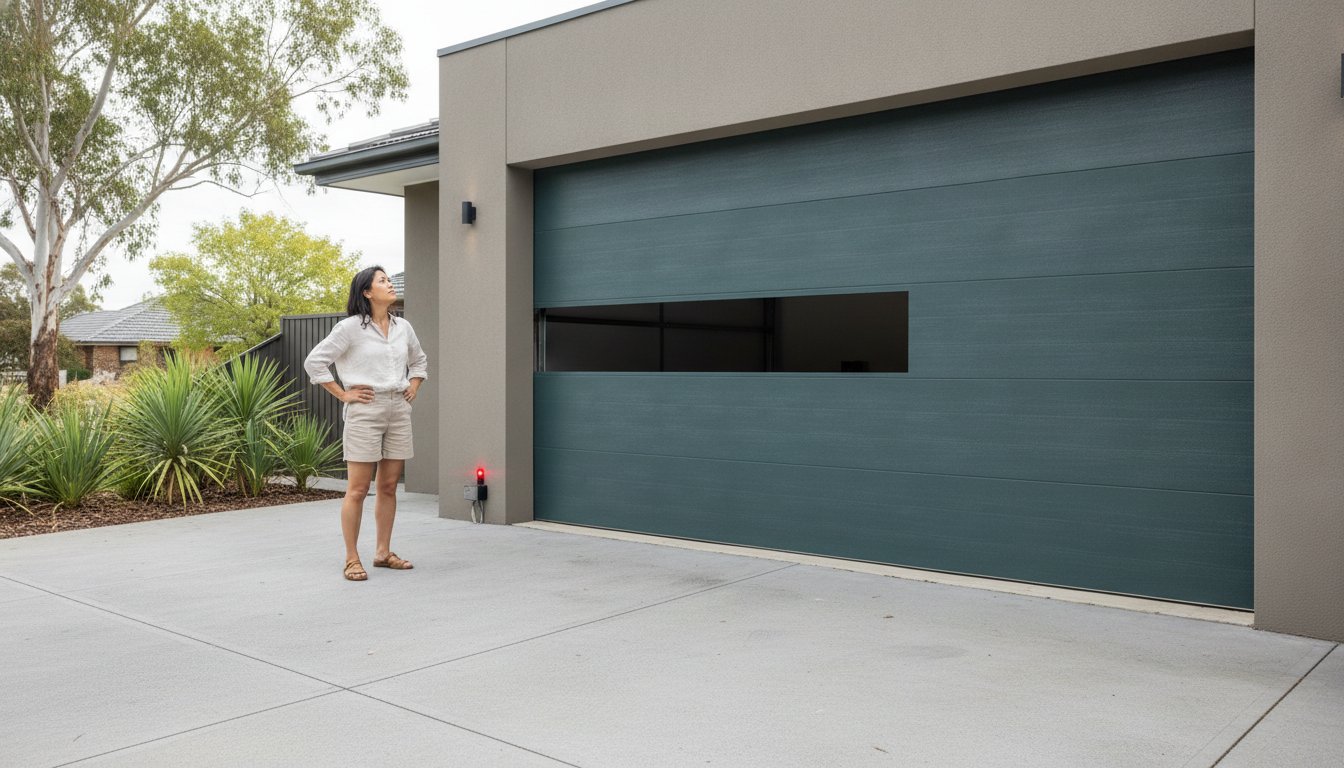
That stubborn garage door refusing to budge isn’t necessarily broken; it’s often just doing its job to keep your family safe. It’s a common frustration for Melbourne homeowners, especially when you’re trying to secure the house for the night or rushing off to work. You find yourself staring at the tracks and wondering, “why is my garage door not closing,” while the sensors blink and the motor hums without any results. We understand the stress of leaving your home vulnerable and the nagging fear of a looming, expensive repair bill.
Discover exactly why your garage door is stuck and how to safely get it moving again with this practical guide. While Australian safety standards like AS/NZS 60335.2.95:2024 mandate specific protections for your peace of mind, these very features can sometimes cause “ghosting” issues that stop a door in its tracks. We’ll walk you through seven essential troubleshooting fixes, ranging from simple sensor alignments to checking for obstructed tracks. This guide provides the clarity you need to decide if you can resolve the issue yourself or if it’s time to call in a local specialist to ensure your home remains secure and your door operates reliably for years to come.
Key Takeaways
- Understand why the safety reverse mechanism causes your door to bounce back and how to spot simple physical blockages.
- Troubleshoot exactly why is my garage door not closing by checking the alignment and cleanliness of your safety sensors.
- Learn the manual release test to quickly distinguish between a motor failure and a mechanical door issue.
- Recognise the specific signs of cable fraying and spring tension loss that make a professional repair essential for your safety.
- Follow a practical step-by-step guide to clear common Melbourne debris and cobwebs that often interfere with your door’s operation.
Common Culprits: Why Your Garage Door Refuses to Shut
It usually happens at the worst possible time. You’re backing out of the driveway, press the remote, and watch as the door begins its descent only to shudder and retreat back to the top. When you find yourself asking why is my garage door not closing, the answer is rarely a total mechanical failure. In most cases, your door is actually working exactly as it was designed to. It has detected a potential hazard and triggered a safety protocol to prevent damage or injury.
Understanding the difference between a motor that has given up the ghost and a system that is simply being cautious is the first step. If you can hear the garage door opener straining or humming, the electrical “brain” of your unit is likely fine. The issue is almost certainly a physical or logical conflict. This could be anything from a misplaced garden trowel in the track to the internal limit settings losing their way after a power surge or a particularly wild Melbourne storm.
The Safety Reverse System
Every modern Australian garage door is fitted with a safety reverse mechanism. This system monitors the amount of force required to move the door. If the motor senses more resistance than expected, it assumes it has hit an object, a pet, or a person, and immediately reverses direction. You might notice the motor unit’s light bulbs flashing several times; this is a diagnostic code telling you the safety system was triggered. It is a vital feature that prevents the door from crushing anything in its path, but it can be overly sensitive if your door isn’t perfectly balanced or if the tracks are clogged with debris.
Physical Obstructions in the Track
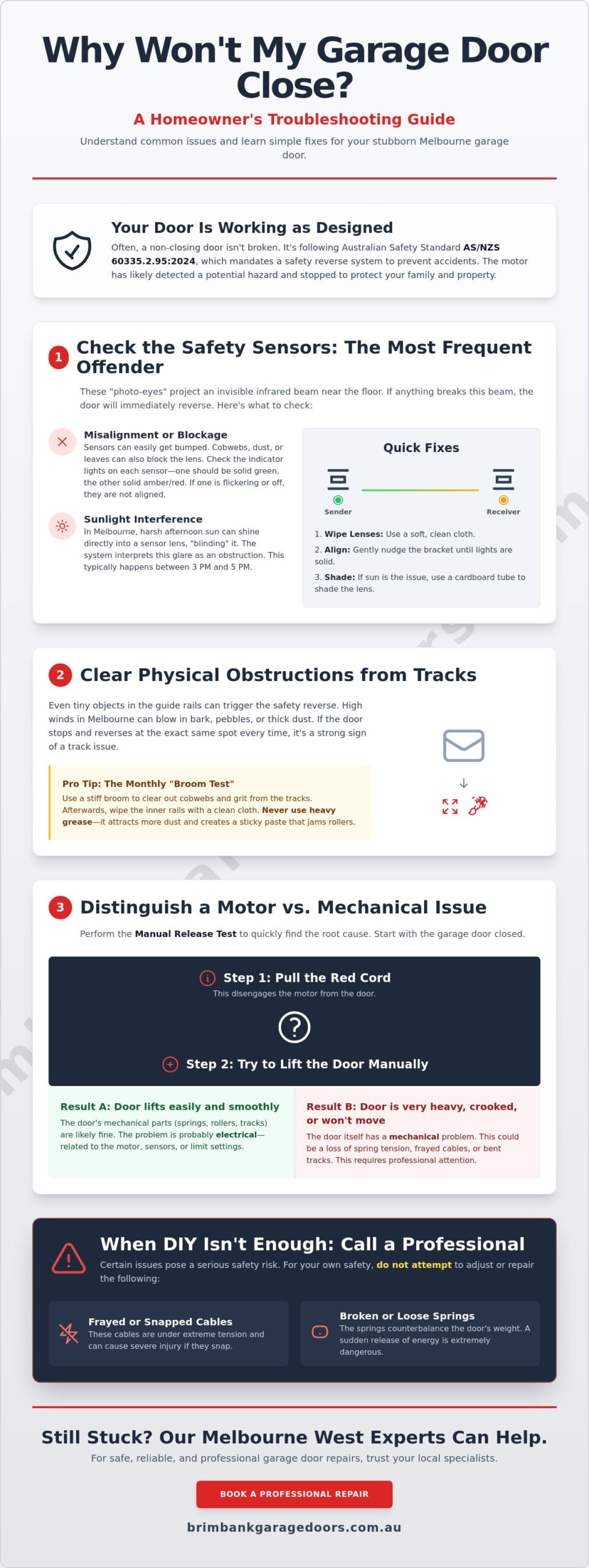
Melbourne’s variable weather often plays a role in door misbehaviour. High winds can blow bark, small stones, or even heavy layers of dust into the guide rails. These tiny obstacles might seem insignificant, but if a roller hits a pebble, the motor registers a spike in resistance and pulls the door back up. Even a slight bend in the track, perhaps from a bumped wheelie bin, can cause enough friction to trigger a reversal. We recommend a simple “broom test” once a month. Use a stiff broom to clear out cobwebs and grit from the tracks, then wipe the inner rails with a clean cloth. Never use heavy grease in the tracks; it actually attracts more Melbourne dust and creates a sticky paste that eventually jams the rollers.
Local temperature swings also affect the metal components. In the peak of a Victorian summer, metal tracks can expand slightly, potentially pinching the rollers. Conversely, extreme cold can thicken old lubricants. If your door stops and reverses at the exact same spot every time, it’s a clear sign of a physical track issue or a limit setting that needs a professional adjustment to account for the door’s travel distance to the floor.
Troubleshooting Safety Sensors: The Most Frequent Offender
If your door starts to descend and then immediately retreats, the safety sensors are the primary suspect. These “photo-eye” units sit just above the floor on each side of the opening, projecting an invisible infrared beam. If anything breaks this beam, the motor won’t allow the door to shut. This is a core requirement of federal safety standards designed to prevent crush injuries. When homeowners find themselves asking why is my garage door not closing, this is the first logical place to check.
Lens Alignment and Cleaning
Melbourne’s wind-blown grit and local spiders often interfere with the signal. A single cobweb across the lens or a thin layer of dust can scatter the infrared beam. Start by wiping the lenses with a soft, clean cloth. Check the LED lights on the back of each unit; typically, one should be green and the other amber or red. If one light is flickering or completely dark, the sensors are out of alignment. Gently nudge the sensor bracket until the light stays solid. If the lights remain off, inspect the thin wires running along the track for any signs of fraying or damage caused by garden tools or pets.
Dealing with Sunlight Interference
In Melbourne’s western suburbs, the harsh afternoon sun can “blind” the receiving sensor. Between 3 PM and 5 PM, the low angle of the sun can hit the lens with enough intensity to overwhelm the infrared signal. The system interprets this glare as a physical obstruction. You’ll notice the door works perfectly in the morning but fails during the afternoon school run. If this is the reason why is my garage door not closing, a temporary fix involves using a small cardboard tube to shade the receiving sensor from direct light.
For a more permanent solution, you might need to reposition the sensors or upgrade to shielded housings. The team at Brimbank Garage Doors & Repairs can provide a professional assessment to ensure your sensors are correctly shielded and secured, keeping your home accessible through every season.
Mechanical vs. Electrical: Identifying the Root Cause
Once you have ruled out dirty sensors and blocked tracks, you need to determine if the issue lies with “the brain” (the electrical components) or “the brawn” (the mechanical hardware). If your motor is straining or making a clicking sound without moving the door, you are likely facing a mechanical failure. Conversely, if the door moves freely but reverses for no apparent reason, the electrical settings or logic board are the probable culprits. If you are still asking why is my garage door not closing after checking the basics, this diagnostic phase is essential to avoid unnecessary part replacements.
The Manual Disconnect Test
The fastest way to isolate the problem is to pull the red emergency release cord. This disconnects the door from the motor, allowing you to move it by hand. Lift the door halfway and let go. A well-balanced door should stay in place or move only slightly. If the door slams shut or feels incredibly heavy to lift, your springs have lost their tension or snapped entirely. In Melbourne, many older homes still use traditional roller doors. These rely on internal springs hidden inside the metal drum. Unlike sectional doors where springs are visible, a roller door’s mechanical failure is often hidden from view, making this manual test the only way to gauge the door’s physical health.
Be extremely cautious during this test. If a spring is broken, the door can weigh over 100 kilograms. Never attempt to pull the release cord while the door is in the open position, as it could crash down without the motor’s resistance to hold it. If the door is too heavy to move manually, the problem is strictly mechanical, and your motor is simply doing its job by refusing to lift a dangerous load.
Logic Board and Remote Issues
A Step-by-Step Guide to Getting Your Door Moving
When you are stuck in your driveway wondering why is my garage door not closing, a systematic approach is the best way to regain your home’s security. Most issues can be resolved by following a logical checklist that moves from the simplest external fixes to internal motor adjustments. Before you begin, ensure the area is clear of pets and children, as a door that suddenly regains its function can move quickly and unexpectedly.
- Step 1: Clear the area. Move any wheelie bins, garden tools, or vehicles away from the door’s path. Even a slight overhang from a car bumper can trigger the safety sensors.
- Step 2: Inspect the sensors. As discussed earlier, these lenses must be spotless. Use a clean, dry microfibre cloth to wipe away dust and cobwebs. Ensure the LED lights on both units are glowing steadily without any flickering.
- Step 3: Check for motor error codes. Look at the main motor unit on your ceiling. Many modern Australian brands like Merlin or B&D use flashing light patterns or beeps to signal specific faults. Consult your manual to see if the flashes indicate a sensor misalignment or a force obstruction.
- Step 4: Perform a manual balance test. If it is safe, pull the red release cord to check if the door moves smoothly by hand. This helps you identify if the motor is struggling against a physical jam or a broken spring, as detailed in the previous section.
- Step 5: Clean the tracks. Use a damp cloth to wipe out the internal “V” of the guide rails. Remove any hardened grease or grit that has accumulated from Melbourne’s windy conditions.
Immediate Fixes for Home Security
If the motor is completely unresponsive, your priority is securing your home. Most roller and sectional doors have manual locking bars on the inside that you can slide into the tracks. If your door doesn’t have these, you can often use a C-clamp on the track just above one of the rollers to prevent the door from being lifted from the outside. While you are inspecting the hardware, avoid the common mistake of using WD-40 on your tracks or rollers. WD-40 is a degreaser, not a long-term lubricant; it actually strips away necessary oils and attracts more dirt. Instead, use a high-quality silicone-based spray on the hinges and springs to keep them moving silently. For professional garage door maintenance that ensures your system remains reliable year-round, reach out to a local specialist.
Resetting the Motor Limits
Sometimes the “brain” of your opener simply forgets where the floor is. This often happens after a power outage or if the door has been bumped. You can usually find “Limit” or “Travel” buttons on the side or back of the motor unit. By following the manufacturer’s sequence, you can “teach” the motor exactly where to stop. Be extremely careful with the “Force” settings during this process. Increasing the force too much can override vital safety features, leading the door to crush objects rather than reversing. If your door is still “thinking” the floor is higher than it actually is, it likely needs a professional limit recalibration from Brimbank Garage Doors & Repairs to prevent further “ghosting” episodes and ensure a tight, secure seal against the concrete.
When DIY Isn’t Enough: Professional Repairs in Melbourne’s West
Sometimes, even after clearing the tracks and wiping the sensors, the door stays put. If you’ve followed the troubleshooting steps above and are still asking why is my garage door not closing, you’ve likely hit a mechanical dead end. While sensor alignment is a safe home task, internal tension issues require specialised tools and technical training that go beyond the average toolbox. A professional service doesn’t just fix the immediate jam; it re-balances the entire system to prevent your motor from burning out prematurely due to excessive strain.
Identifying the point where DIY becomes dangerous is vital for your safety. If the motor hums but the door doesn’t move, or if it only moves a few centimetres before stopping, the physical weight of the door has become too much for the opener to handle. This usually points to a failure in the counterbalancing system. In Melbourne’s western suburbs, where roller doors are a standard feature, these mechanical components eventually fatigue after years of daily cycles and exposure to our variable Victorian weather. For a comprehensive overview of what professional service involves, the roller door repairs Melbourne homeowners guide covers everything from spring replacements to motor overhauls in detail.
While structural fatigue is a concern for doors, the roof above them often offers a different opportunity for home improvement. For homeowners with flat garage roofs interested in sustainable upgrades, you can visit Zonnepanelen Brabant B.V. to learn how ballast solar systems can be installed efficiently without compromising the roof’s integrity.
The Dangers of High-Tension Springs
Garage door springs are the heavy lifters of the system. They store immense torque to offset the weight of the steel curtain or sectional panels. When a spring snaps or loses its tension, the motor simply cannot lift the load safely. Unlike the simple sensor blocks we covered earlier, a broken spring makes the door physically dangerous to move manually. DIY spring repair is a high-risk activity that can lead to severe injury or significant property damage if the tension is released incorrectly. If your manual balance test revealed a door that feels like a lead weight, the springs have reached the end of their functional life. Residents in the area can find trusted garage door repairs Keilor specialists who handle high-tension spring replacements safely and to Australian standards.
You might also notice the lifting cables starting to “bird-nest” or tangle around the drum. This usually happens when the door has become unbalanced or the springs have failed to provide even tension. If you see frayed wires or cables hanging loose, stop using the door immediately. Forcing a motor to work against tangled cables can strip the internal gears of your opener, turning a simple cable reset into a much more expensive motor replacement.
Local Expertise You Can Depend On
Matt from Brimbank Garage Doors & Repairs has spent years helping families across Melbourne’s western suburbs restore their home security. We specialise in roller door repairs Melbourne homeowners rely on, and spring replacements, ensuring every fix meets rigorous Australian safety standards. We know that a door stuck open is a safety risk for your family and your vehicles, which is why we prioritise straightforward communication and reliable, hands-on solutions that last.
Choosing a local specialist ensures you’re dealing with someone who understands the specific needs of Melbourne homes and the common failures of local door brands. We take pride in our craftsmanship and offer comprehensive maintenance to keep your door running silently for years to come. Stuck in the driveway? Contact Brimbank Garage Doors & Repairs for a reliable fix.
Secure Your Home and Restore Reliability
A garage door that won’t shut is more than a minor annoyance; it’s a gap in your home’s security that needs a quick, reliable solution. By now, you should have a much clearer understanding of why is my garage door not closing, whether it’s a simple case of Melbourne dust on the sensors or a more complex issue with the motor’s limit settings. While many of these troubleshooting steps are safe to handle yourself, remember that your door’s physical balance and high-tension springs are best left to those with the right tools and expert knowledge.
If you’ve cleared the tracks and aligned the sensors but the door still refuses to budge, it’s time to call in a local professional. As a specialist in Melbourne’s western suburbs, Matt at Brimbank Garage Doors & Repairs focuses on residential roller door repairs with a commitment to quality and family safety. From fitting high-quality replacement springs to performing comprehensive maintenance, we ensure your door operates smoothly for the long haul.
Get your garage door back on track with Matt at Brimbank Garage Doors and enjoy the peace of mind that comes with a secure, functional home. We’re ready to help you get moving again.
Frequently Asked Questions
Why does my garage door start to close and then go back up?
Your door is likely triggering its safety reverse system. This happens when the motor detects physical resistance or a broken sensor beam, causing it to retreat to the open position for safety. If you’re wondering why is my garage door not closing, start by checking for small objects like pebbles or garden tools in the tracks that might be causing a blockage.
How do I know if my garage door sensors are misaligned?
Check the small LED lights on the back of each sensor unit near the floor. A solid light on both indicates they are “seeing” each other perfectly. If one light is flickering or completely dark, the sensors are misaligned. You should gently nudge the bracket back into position until the light glows steadily without any flickering.
Can I close my garage door manually if the motor isn’t working?
You can close the door by pulling the red emergency release cord to disconnect the motor. However, you must be extremely careful if you suspect a broken spring. Without the spring’s tension, the door can be incredibly heavy and may crash down, so only attempt this if the door feels balanced and easy to move by hand.
Why is the light on my garage door motor flashing?
Flashing lights are your motor’s way of communicating a specific fault code. Most major Australian brands use light patterns to signal that the safety sensors are blocked or that the door has hit an obstruction. Check your user manual to decipher the exact number of flashes, as this often points directly to the reason why is my garage door not closing.
Will sunlight really stop my garage door from closing?
Glare from the low afternoon sun can absolutely “blind” your safety sensors. This is a frequent issue in Melbourne’s western suburbs during the summer months. The infrared beam is overwhelmed by the sun’s intensity, making the system think there is an object in the path. A simple cardboard sun shield often solves this problem immediately.
Is it safe to spray WD-40 on my garage door tracks?
You should avoid using standard WD-40 on your tracks. While it’s a great degreaser, it actually attracts Melbourne dust and grit, which eventually creates a sticky paste that jams your rollers. Instead, use a high-quality silicone-based lubricant on the hinges and rollers to ensure quiet, smooth operation without the messy buildup.
What should I do if I hear a loud bang and the door won’t move?
Stop trying to operate the door immediately and stay clear of the opening. A loud bang usually signifies that a high-tension spring has snapped. Because the spring is responsible for lifting the door’s weight, the motor will no longer be able to function safely. This is a serious mechanical failure that requires professional attention to prevent injury.
How often should I have my garage door serviced in Melbourne?
We recommend a professional service once every 12 months. Regular maintenance can prevent approximately 73% of warranty claims and significantly extends the life of your motor and springs. Given that a quality door in Australia should last 15 to 20 years, an annual check-up is a small investment in your long-term home security.